

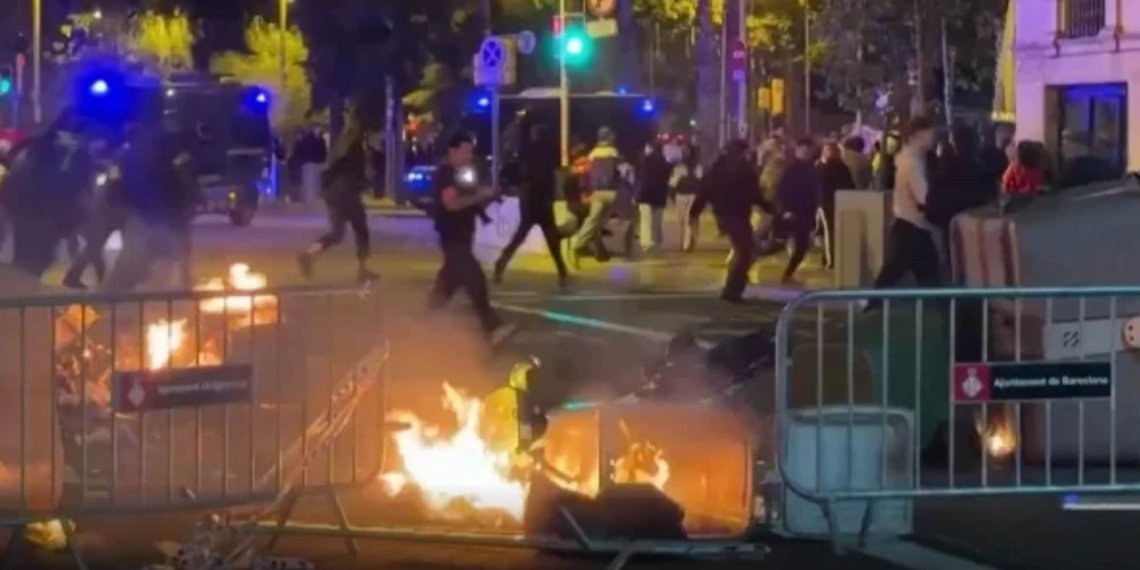
New Delhi : Spain witnessed widespread unrest on Wednesday as a nationwide general strike over soaring housing costs and a deepening accommodation crisis turned violent in several major cities, including Barcelona and Madrid.
The strike, backed by the country’s leading labour unions, the General Union of Workers (UGT) and Workers’ Commissions (CCOO), alongside tenant organisations, reportedly drew nearly four million participants. Workers and housing activists took to the streets demanding affordable homes, lower rents and stronger government action to address the growing housing shortage.
What began as largely peaceful demonstrations escalated into confrontations with police as the day progressed. In Barcelona, protesters reportedly set fire to furniture and debris on city streets, while clashes broke out with security personnel. In Madrid, riot police used tear gas, pepper spray and foam projectiles to disperse demonstrators near the central Plaza de España.
Authorities reported at least 73 arrests across the country by 2100 GMT, following 1,044 strike-related incidents involving demonstrations, industrial blockades and burning rubbish containers.
Housing Crisis Fuels Public Anger
The protests come amid mounting frustration over Spain’s worsening housing shortage, with the country facing an estimated deficit of 750,000 homes. The gap is projected to surpass one million by 2028, further intensifying pressure on an already strained rental market.
According to the Youth Council of Spain, the average monthly rent has reached €1,176, consuming approximately 98.7% of the average monthly salary of a young worker.
The situation has left many young Spaniards struggling to secure independent accommodation. Jesus Gonzalez, a 36-year-old IT professional from Madrid, said rising rents and property prices had made living independently increasingly difficult.
Public anger has also intensified following the eviction and subsequent death of an 87-year-old woman in Madrid, while parliament’s rejection of government measures intended to restrict evictions has added to the controversy.
Industries Disrupted, Unions Challenge Police Action
The nationwide strike disrupted several key sectors of the Spanish economy. Labour unions claimed participation reached 90% in ports and the automotive industry, with Volkswagen’s Navarre facility and SEAT’s Barcelona factory reportedly coming to a complete standstill.
Electricity demand dropped by as much as 15.5% during the morning, while public transport services also experienced significant disruption.
Meanwhile, tensions between unions and law enforcement escalated after organisers accused police of using excessive force against demonstrators. Unions alleged that baton charges and tear gas injured around 20 protesters and threatened legal action over what they described as a disproportionate police response.
Political Pressure Mounts Ahead of Elections
The growing housing crisis has emerged as a major political flashpoint ahead of Spain’s November 29 snap general election called by Prime Minister Pedro Sanchez.
With housing affordability, rising rents and evictions dominating public debate, the nationwide mobilisation has placed additional pressure on the government to deliver meaningful solutions.
The protests highlight the growing frustration among ordinary Spaniards, particularly younger generations, for whom owning or even renting a home is becoming increasingly unaffordable.
