

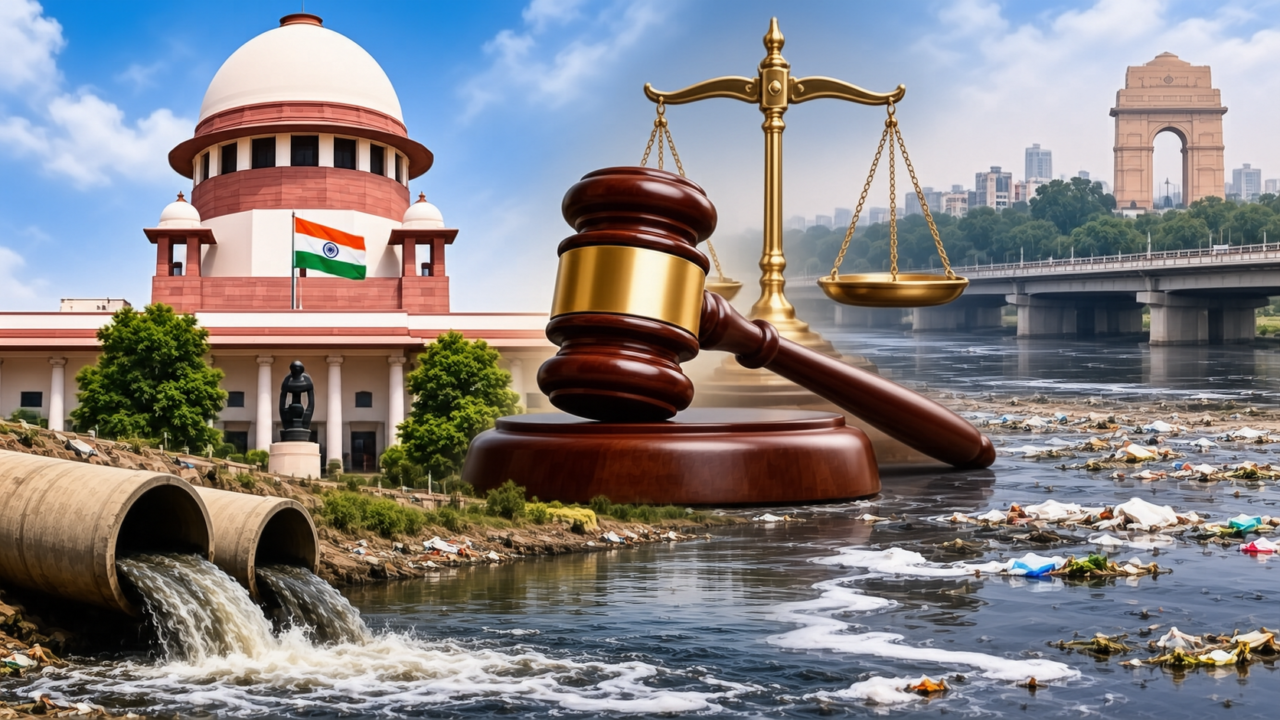
New Delhi : The Supreme Court has stepped up its crackdown on Yamuna pollution, warning that states, Union Territories and districts could face financial penalties if the river’s water quality deteriorates while passing through their respective jurisdictions.
A bench of Justices Manoj Misra and Manmohan directed that the concerned authorities deposit compensation or fines directly with the Supreme Court Registry whenever pollution levels worsen. The Central Pollution Control Board (CPCB) has been asked to develop a penalty framework, while state governments can recover the amount from responsible polluters and negligent officials after due inquiry.
Delhi Under the Scanner
The court expressed serious concern over the deteriorating condition of the Yamuna, particularly in Delhi, where a 22-km stretch between Wazirabad and Okhla contributes a significant share of the river’s pollution despite accounting for only a small portion of its total length.
The bench highlighted that 520 drains discharge nearly 9,667 million litres of wastewater daily into the river. It also observed that none of Delhi’s 37 sewage treatment plants currently meets all prescribed standards.
The court further directed authorities to remove illegal encroachments, unauthorised colonies, JJ clusters along drains, illegal dairies and settlements on the riverbed, subject to rehabilitation of eligible residents. Protection of Delhi’s Zone ‘O’ under the Master Plan 2047 was also emphasised.
Strict Monitoring and Accountability
As part of a comprehensive Yamuna Action Plan, the Supreme Court ordered the installation of tamper-proof smart energy meters and continuous water-quality monitoring systems at sewage treatment plants, common effluent treatment plants and government-operated biogas facilities.
The monitoring systems must track parameters including pH, BOD, COD, total suspended solids and ammoniacal nitrogen, with data made publicly available through CPCB and state pollution control board websites.
Any interruption in data transmission exceeding 24 hours will create a presumption that the treatment plant has stopped functioning.
The court also directed the CPCB to arrange surprise quarterly inspections of STPs with a capacity of 5 MLD or more and CETPs through IITs, NITs or accredited laboratories.
Additionally, GPS tracking of septage tankers has been mandated, and senior nodal officers must be appointed within two weeks.
The proposed action plan includes 125 new sewage treatment plants, 12 common effluent treatment plants in Haryana and 23 biogas plants.
The Supreme Court has scheduled the next hearing for January 13, 2027, signalling a stricter approach towards holding authorities accountable for the Yamuna’s deteriorating condition.
