

 newspop
Is November 13, 2026 Really the Last Day of Earth ? Here’s What the Science Actually Says
SPECIAL STORY : A date is going viral. A 60-year-old mathematical formula has pointed toward November 13, 2026 and the claim is sending shockwaves across social media. Imagine waking up one morning to a world where food is scarce, water is running out, cities are bursting at the seams and humanity is fighting simply to survive. Now imagine someone claiming that a mathematical calculation has already identified the date when such a nightmare could reach its extreme point November 13, 2026.
The date is just months away, and social media is turning it into a chilling “Friday the 13th doomsday” prediction. But behind the frightening headlines lies an extraordinary scientific story dating back to 1960. Researchers studying the explosive growth of the global population calculated a theoretical point that falls on this very date.
So, is November 13 really the last day of Earth ? Could humanity actually face an apocalypse on that Friday ? Or has an old mathematical warning been transformed into a terrifying internet rumour ?
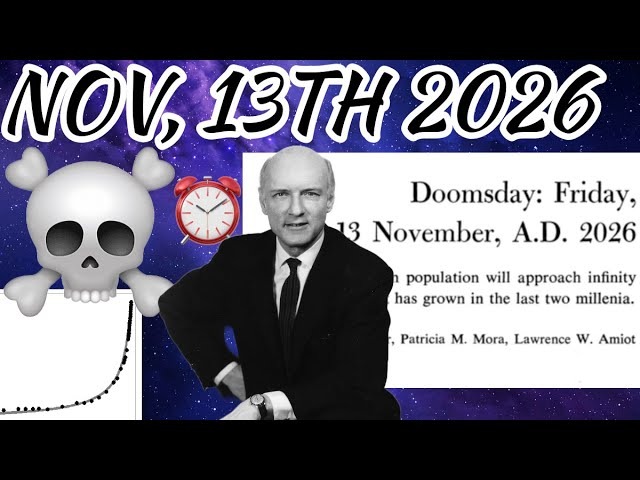
A frightening claim is spreading across social media that November 13, 2026 could mark the “end of the world.” With the date falling on a Friday, the prediction has triggered fresh curiosity and fear online. But is there really a scientific basis for believing that humanity will come to an end on that particular day ?
The answer is no. There is no credible scientific evidence suggesting that Earth will be destroyed or that human civilisation will suddenly end on November 13, 2026. The viral claim is linked to a mathematical population-growth study published in 1960, but its original message has often been exaggerated and misunderstood.
Where Did the November 13 Date Come From ?
The claim can be traced back to a 1960 paper published in the journal Science by Heinz von Foerster, Patricia Mora and Lawrence Amiot. The researchers examined historical population growth and developed a mathematical model to explore what could happen if the rapid growth trend of that period continued indefinitely.
Their calculations produced November 13, 2026 as a theoretical point at which population growth would reach an extreme mathematical limit under the assumptions of their model.
But importantly, the researchers were not predicting that the Earth would literally explode or that everyone would die on that date. Instead, the study was intended as a warning about the consequences of uncontrolled population growth and the enormous pressure that an expanding human population could place on food, resources, the environment and social systems.
Why Did the Prediction Sound So Terrifying ?
At the time, the world’s population was increasing at a historically rapid pace. Medical advances had reduced mortality, while birth rates remained high in many parts of the world.
The mathematical model assumed that such rapid growth would continue indefinitely. Under that assumption, the numbers eventually become extraordinarily large, creating a theoretical scenario involving severe resource shortages, overcrowding and environmental pressure.
This is where the idea of “population explosion” comes from. The frightening scenarios associated with the study included the possibility of shortages of food and water, environmental degradation, social instability and increasing competition for resources.
However, these were consequences of a mathematical extrapolation, not a prophecy that a specific disaster would occur on November 13, 2026.
The World Has Changed Since 1960
One of the biggest problems with applying the 1960 calculation literally to 2026 is that population growth did not continue along the same trajectory.
Birth rates have declined significantly in many countries as education, urbanisation, healthcare access and economic changes have transformed societies.
The global population is still growing, but the rate of growth has slowed considerably compared with the middle of the 20th century.
Current demographic projections also do not indicate a sudden population-driven apocalypse in 2026. Instead, the United Nations expects global population growth to eventually slow further, with the world’s population projected to reach a peak around the 2080s before gradually declining.
So, What Will Happen on November 13 ?
Nothing scientifically established suggests that November 13, 2026, will be the final day of Earth.
There is no confirmed asteroid impact, planetary collision or other known astronomical event scheduled for that date that would destroy humanity.
The viral claim is essentially based on taking an old mathematical model and treating its theoretical endpoint as a literal doomsday prediction.
But the Warning Still Matters
Although the specific date is not a reason to panic, the underlying message of the 1960 study remains relevant.
Humanity still faces major challenges involving climate change, water scarcity, food security, biodiversity loss, pollution and pressure on natural resources.
The real lesson is not that the world will end on a particular Friday. Rather, it is that human societies cannot grow and consume resources without limits.
Nature has repeatedly shown that environmental pressure can create serious consequences. Managing resources responsibly, reducing environmental damage and addressing climate change remain essential for protecting future generations.
November 13, 2026 is NOT a scientifically predicted doomsday
The date came from a 60-year-old mathematical population-growth model, not from a modern prediction of Earth’s destruction. So there is no reason to panic over the viral claim but there is every reason to take the study’s broader warning about population, resources and the environment seriously.