
 newspop
Forget Hollywood Zombies Nature Has Its Own Version
What if the most terrifying “zombie” stories were not completely fictional ? Somewhere in the natural world, tiny organisms are capable of doing something that sounds straight out of a horror movie they can alter the behaviour of their hosts, turning ordinary animals into creatures that appear to follow a strange biological command.
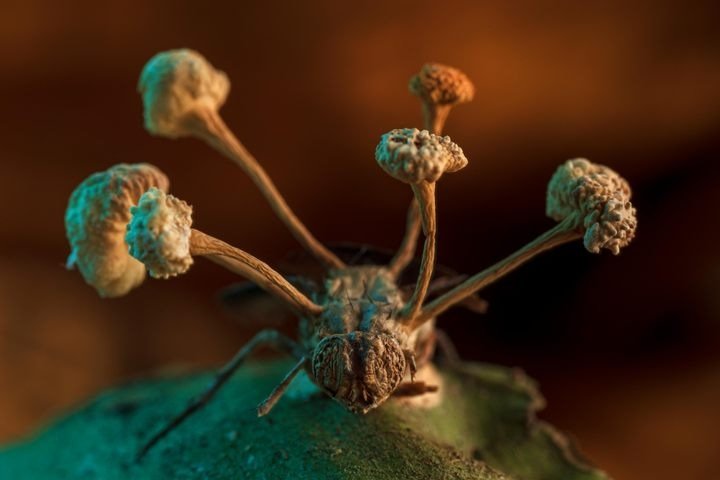
One of the most astonishing examples is the Ophiocordyceps fungus, popularly known as the “zombie-ant fungus.” Certain species of this fungus infect ants and can manipulate aspects of their behaviour in ways that benefit the fungus. An infected ant may leave its normal path, move toward a particular location on vegetation and eventually clamp its jaws onto plant material in what scientists describe as a highly specific behavioural pattern.
After the ant dies, the fungus continues developing inside and eventually emerges from the body, producing structures that release spores into the surrounding environment. Those spores can then infect other ants, allowing the fungal life cycle to continue. The phenomenon is so bizarre that it has become one of nature’s most famous examples of parasite-host manipulation, but scientists stress that this is not supernatural mind control it is the result of an extraordinarily complex biological interaction that has evolved over time. Another organism that has fascinated researchers is Toxoplasma gondii, a microscopic parasite capable of infecting a wide range of warm-blooded animals.
In rodents, infection has been associated with changes in fear-related behaviour, including reduced avoidance of areas associated with cats. This unusual relationship makes biological sense from the parasite’s life-cycle perspective because cats are the definitive hosts of Toxoplasma gondii, meaning the parasite completes its sexual life cycle in felines. If an infected rodent becomes less fearful and is more likely to encounter or be eaten by a cat, the parasite can potentially reach the host in which it reproduces.
It is this remarkable interaction that has fueled countless “mind-control parasite” stories online. But there is an important scientific distinction: humans can become infected with Toxoplasma gondii, but there is no established scientific evidence that the parasite turns humans into zombies or gives it the ability to remotely control human behaviour in the dramatic way portrayed in movies and viral posts.
Human infection can occur through several routes, including exposure to contaminated food or soil and consumption of undercooked infected meat, while many healthy people may experience no obvious symptoms. However, certain people, particularly those with weakened immune systems, can develop serious complications, making proper medical guidance important. Another disease frequently dragged into “zombie” comparisons is rabies. Rabies is a deadly viral disease that attacks the nervous system and can produce severe neurological symptoms, including agitation, confusion, abnormal behaviour, hallucinations, difficulty swallowing and fear or difficulty around drinking water.
These symptoms can look frightening and dramatic, but rabies is not mind control and is not caused by a fungus or parasite. It is a viral infection that can spread through the saliva of an infected animal, most commonly through bites. Once clinical symptoms appear, rabies is almost always fatal, which is why immediate medical attention following a possible exposure is critical. Beyond these famous examples, the natural world is filled with organisms that have evolved extraordinary strategies to survive and reproduce. Some parasites can change the movement, feeding patterns or defensive behaviour of their hosts, while certain fungi can exploit insects and other animals as part of their reproductive cycle. These interactions may appear horrifying from a human perspective, but from an evolutionary standpoint they represent complex relationships shaped by millions of years of natural selection.
The truly shocking part is not that humans are secretly surrounded by “zombie makers,” but that nature itself has already evolved biological mechanisms capable of influencing animal behaviour with remarkable precision. Yet despite the sensational claims that frequently spread across social media, scientists have found no evidence that humans can be transformed into movie-style zombies by Ophiocordyceps, Toxoplasma gondii or similar organisms. The real science is already strange enough: fungi can manipulate insects, parasites can influence host behaviour, and viruses such as rabies can profoundly affect the nervous system. So, while Hollywood’s walking dead remain fiction, nature’s real-life “zombies” are very much a scientific reality but they are mostly insects and other animals, not humans.