
 newspop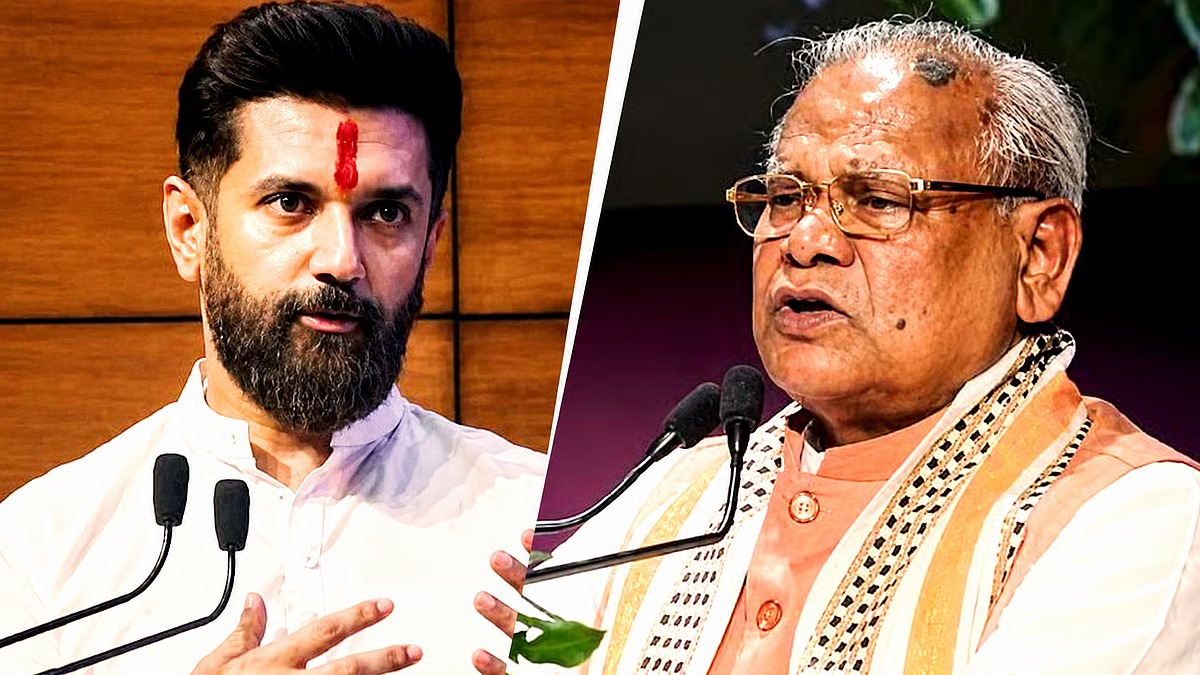
New Delhi: A fresh political fault line has emerged within the BJP-led NDA, with Union ministers and allies Chirag Paswan and Jitan Ram Manjhi openly clashing over the contentious issue of reservation for Scheduled Castes (SCs) and the question of sub-classification or a “creamy layer” within reserved categories. The public disagreement between the two leaders has attracted considerable political attention because both are important NDA allies and prominent voices representing different sections of Bihar’s Dalit electorate.
The confrontation has gone beyond a policy disagreement, with sharp remarks and even demands for resignation being exchanged, highlighting the complex social and electoral calculations surrounding caste politics in Bihar. At the centre of the dispute is the question of whether the existing SC reservation system should be reviewed to ensure that the most disadvantaged communities receive a greater share of its benefits.
Manjhi has argued that some Dalit communities remain significantly more deprived than others and therefore deserve greater access to reservation benefits and government welfare schemes. His position reflects a long-standing political demand for greater representation for the most marginalised sections within the broader Scheduled Caste category.
Paswan, however, has strongly opposed the idea of creating further divisions within the Dalit community through sub-classification or a creamy-layer mechanism. He has argued that such an approach could create divisions among Dalits and weaken the broader social unity of the community. The political disagreement is particularly significant because the two leaders draw support from different social constituencies in Bihar.
Chirag Paswan’s political influence is strongly associated with the Paswan or Dusadh community, while Jitan Ram Manjhi has emerged as an important political voice among the Musahar community and other extremely disadvantaged Dalit sections. The competing positions therefore carry implications beyond policy and reflect the wider struggle for influence over Bihar’s Dalit vote.
For Manjhi, the argument centres on ensuring that communities that have historically remained at the bottom of the socio-economic ladder receive a larger share of opportunities created through affirmative action. For Paswan, the priority is protecting the existing reservation framework and preventing further internal divisions among Dalits. The disagreement also has a political backdrop, as Bihar’s caste equations have increasingly become central to electoral strategies and alliance politics.
Both leaders remain part of the NDA framework, but their contrasting positions demonstrate how social representation and community-specific demands can create tensions even within an alliance. The controversy also recalls earlier debates within Bihar’s Dalit politics over the categorisation of “Mahadalit” communities and the distribution of benefits among different Scheduled Caste groups.
As the debate intensifies, the issue could become an important talking point in Bihar’s political discourse, particularly at a time when parties are seeking to consolidate support among different caste and social groups. The Chirag-Manjhi confrontation is therefore not merely a personal or ministerial dispute; it reflects a deeper contest over reservation policy, Dalit representation, social justice and political influence.
How the NDA leadership manages the disagreement could be closely watched, as any prolonged public confrontation between two prominent allies could have implications for the alliance’s social coalition in Bihar and potentially influence the broader national debate on reservation and affirmative action.