 newspop
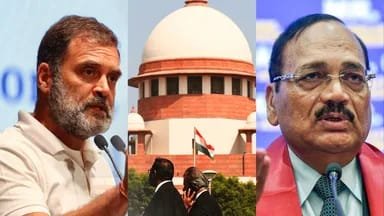
New Delhi : Chief Justice of India (CJI) Surya Kant sharply reprimanded a lawyer on Tuesday. The lawyer had sought to mention a case involving allegations of “disproportionate assets” against Congress leader and Leader of the Opposition in the Lok Sabha, Rahul Gandhi. In response, the CJI asked the lawyer representing the petitioner whether he had spoken to any news channels regarding the matter. He also questioned the manner in which the case was brought up, noting that it lacked both a clear basis and a definitive conclusion.
According to reports, during the hearing, the CJI remarked that there appeared to be no solid ground for raising the matter. He asked, “Have you spoken to any news channels about this?” This comment came as a request was being made to list a case in court concerning allegations of disproportionate assets against the Leader of the Opposition, Rahul Gandhi. The lawyer argued that Rahul Gandhi had recently claimed at an event that he was in contact with approximately 200 officers from the Enforcement Directorate (ED) and the Central Bureau of Investigation (CBI).
During these proceedings, CJI Surya Kant issued another significant oral directive, instructing court staff to discontinue the live streaming of the “mentioning” of cases.
In the Supreme Court, the “mentioning” process allows lawyers to request that a case be listed for an early hearing. Given this context, the CJI’s remarks and his directive to halt live streaming have become a subject of discussion.
The case against Rahul Gandhi stems from a petition filed by S. Vignesh Shishir, a BJP worker from Karnataka. The petitioner alleged that Rahul Gandhi and some members of his family possess assets disproportionate to their known sources of income. On this basis, the petitioner sought an investigation by the relevant investigative agencies.
Following these allegations, the matter reached the Lucknow Bench of the Allahabad High Court. In May 2026, the High Court directed the Central Bureau of Investigation (CBI) and the Enforcement Directorate (ED) to verify the allegations made in the complaint in accordance with the law and to provide an update on the progress of the matter.
Subsequently, on July 20, 2026, the High Court expressed dissatisfaction with an affidavit filed by the CBI. The court directed the agency to file a fresh affidavit providing clear information regarding the progress of the investigation. Regarding the ED, the High Court further observed that if any material pertaining to illegal activity is uncovered during the investigation, the agency may initiate further action in accordance with the law.
Rahul Gandhi challenged the Allahabad High Court’s orders before the Supreme Court. Appearing on his behalf, Senior Advocate Kapil Sibal argued that the manner in which the proceedings were unfolding was not in accordance with the due process of law. He also questioned the petitioner’s standing to file the petition, as well as the petitioner’s underlying motives.
On August 17, 2026, a three-judge bench—presided over by Chief Justice Surya Kant and also comprising Justice Joymalya Bagchi and Justice V. Mohana—intervened in the matter.
The Supreme Court directed the Allahabad High Court to stay further hearings in the case. Additionally, it instructed the CBI, the ED, and any other relevant investigative agency not to submit any reports to the High Court until further orders are issued by the Supreme Court.
During the proceedings, the Supreme Court also questioned why the investigative agencies—if they indeed possess concrete evidence regarding the allegations are not acting independently, as they are empowered to do under their statutory authority. The court also stated that an investigative agency does not, in every instance, require a court directive to initiate action against an individual.
Furthermore, the bench questioned how the High Court could issue such directives which could potentially affect Rahul Gandhi without providing him an opportunity to be heard. The court emphasized the necessity of adhering to the principles of natural justice.
Report : Abhijit Tushar Bhatt (Political Editor)