
 newspop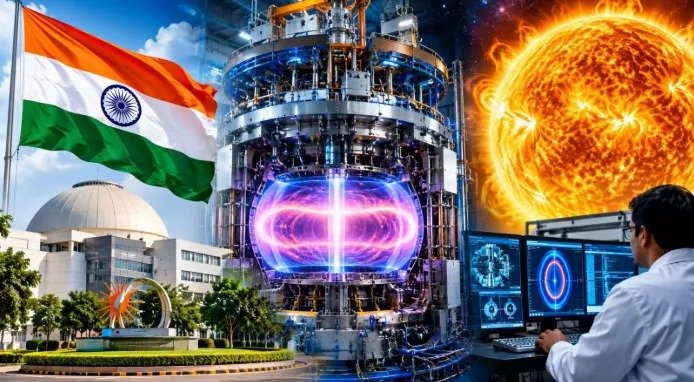
Not a Real Sun, But Something Incredible: India’s High-Temperature Fusion
India is taking another major step in the global race to develop fusion energy, with scientists at the Institute for Plasma Research (IPR) in Gandhinagar, Gujarat, strengthening the country’s fusion research capabilities through the SST-1 (Steady State Superconducting Tokamak). A new and more powerful gyrotron system has been integrated with the SST-1, operating at a frequency of around 82.6 GHz with a power output of 400 kW.
The system is designed to provide high-frequency microwave energy to heat extremely hot plasma inside the tokamak and help scientists study how such plasma can be maintained in a stable and controlled state for longer periods. Often described as an “artificial sun,” a fusion device does not actually create a miniature sun, but attempts to reproduce the nuclear fusion process that powers the Sun under controlled conditions on Earth.
Unlike the Sun, Earth does not have the enormous gravitational pressure needed to naturally confine fusion fuel, so researchers use powerful magnetic fields inside machines known as tokamaks to confine and control superheated plasma. India has already demonstrated its capabilities in high-temperature plasma research, with Indian scientists achieving plasma temperatures exceeding 200 million degrees Celsius in fusion experiments far hotter than the temperature at the centre of the Sun.
However, generating extreme temperatures is only one part of the challenge; the bigger scientific goal is to keep the plasma sufficiently hot, stable and confined for a sustained period so that fusion reactions can eventually become a practical source of energy. This is where the upgraded gyrotron technology becomes important, as it can deliver powerful microwave energy to the plasma, supporting experiments aimed at improving heating and plasma control.
China has also made significant progress in this field through its EAST (Experimental Advanced Superconducting Tokamak) facility, widely referred to as an “artificial sun” in popular reporting, which has conducted long-duration high-temperature plasma experiments. In 2025, EAST reported sustaining a high-confinement plasma operation for more than 1,000 seconds, highlighting the scale of the technical challenge involved in achieving long-duration fusion conditions. For India, the continuing development of SST-1 represents an important part of its broader effort to build expertise in fusion science and technology.
If researchers eventually succeed in making controlled nuclear fusion commercially viable, the technology could potentially provide a large-scale source of electricity with very low direct carbon emissions during operation and could help reduce dependence on fossil fuels such as coal, oil and natural gas. However, commercial fusion power remains a major technological challenge and is still under development worldwide. For ordinary people, the potential long-term benefit could be cleaner and more reliable electricity, but such benefits would depend on future breakthroughs in sustained fusion, energy gain, engineering, cost and commercial power generation.



 Mudasir Maqbool