

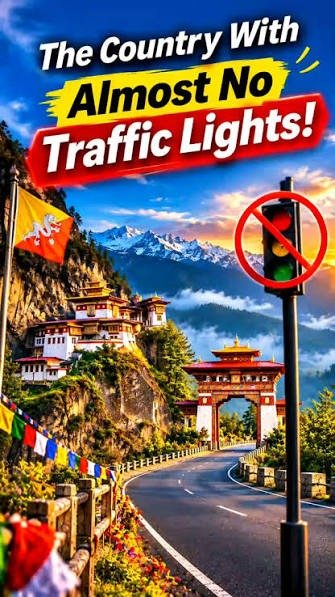
Imagine driving through a busy capital city where you will not find a single red, yellow or green traffic signal! No countdown timers, no electronic lights and no automated signals to tell vehicles when to stop or move. Yet, traffic continues to flow through human instructions and discipline. Sounds unbelievable? This is the fascinating reality of Bhutan.
Located in the lap of the Himalayas, Bhutan has attracted worldwide attention for its unusual traffic management system, particularly in its capital city, Thimphu. Unlike most modern cities that depend on electronic traffic signals to regulate vehicles, Thimphu relies on traffic police officers who manually control the movement of vehicles and pedestrians.

Dressed in their uniforms, wearing white gloves and standing inside beautifully designed traditional traffic booths, these officers use carefully coordinated hand gestures to direct vehicles, manage intersections and help pedestrians cross the roads. Their movements ensure that traffic follows an organised pattern without the familiar red, yellow and green lights seen across cities around the world.
The country’s unique traffic arrangement recently caught the attention of social media users after content creator Ian Gifford shared a video on Instagram on October 1, showcasing a traffic police officer performing his duty in Thimphu. In the video, the officer can be seen standing inside an intricately designed booth and directing vehicles and pedestrians through simple hand signals.

The video sparked curiosity among viewers, with many expressing surprise at how a capital city could manage traffic without conventional electronic signals. Gifford also shared his thoughts in the caption, suggesting that he would prefer following the directions of a real person rather than waiting at a red traffic light.
But there is an interesting story behind Bhutan’s decision to continue with this traditional system. The country did, in fact, experiment with modern electronic traffic signals during the late 1990s. Traffic lights were reportedly installed at a major intersection in Thimphu as part of an effort to modernise traffic management and handle the increasing number of vehicles.

However, the experiment did not continue for long. Local residents reportedly expressed dissatisfaction with the new arrangement, and the electronic signals were eventually removed. The familiar human-controlled system returned, with traffic officers once again taking charge of the intersection.
One reason often associated with Bhutan’s preference for this arrangement is its distinctive cultural atmosphere and emphasis on personal interaction. The traditional traffic booths, the officers’ disciplined movements and the relatively simple approach to regulating vehicles have become an interesting part of Thimphu’s identity.
For visitors, watching a traffic officer control an intersection through hand gestures rather than electronic signals is an experience quite different from what they encounter in other countries.
However, Bhutan’s traffic system should not be understood as meaning that the country has no traffic rules or that every road is free from congestion. Traffic regulations, road discipline and the presence of traffic authorities remain important. The absence of conventional traffic lights in Thimphu’s well-known traffic arrangement is what makes the city particularly distinctive.
At a time when cities across the world are investing heavily in smart traffic signals, surveillance cameras, automated systems and advanced technologies to manage growing traffic volumes, Bhutan’s approach offers a fascinating contrast. It highlights the importance of human involvement, public cooperation and disciplined road behaviour alongside modern infrastructure.
A country where a traffic officer’s hand gesture can replace an electronic signal, where a traditional booth has become a symbol of the capital, and where an experiment with traffic lights reportedly gave way to an older system! Bhutan’s unique traffic arrangement has certainly captured the world’s curiosity. But the big question remains: Would you prefer following a traffic officer’s hand signals or waiting for the familiar red, yellow and green lights ?