 newspop
New Delhi : The Supreme Court has agreed to hear a petition filed against Chief Election Commissioner (CEC) Gyanesh Kumar. The apex court will hear the matter next week. The petition alleges that Gyanesh Kumar took several decisions in the name of the Election Commission of India (ECI) without the approval of the other two Election Commissioners. Senior Advocate Vikas Singh mentioned the matter before Chief Justice of India (CJI) Surya Kant on Tuesday. Following this, the CJI directed that the case be listed for hearing next week.
According to a Bar & Bench report, petitioner Rakesh Kumar Singh has alleged a continuous centralization of power within the Election Commission implying that “a single person is making the decisions.” The petitioner’s counsel stated, “The objective of a multi-member commission and the law mandates this is that decisions should be taken either unanimously or by a majority. Now, given the manner in which the Election Commission has functioned, there is serious doubt as to whether the Commission actually took a decision regarding the entire ‘Special Intensive Revision’ (SIR) process. If the Commission did not reach a unanimous decision… [it matters, because] the verdict delivered by the Court was also based on the premise that it was a decision of the Commission. Therefore, this is a serious matter.” In response, the CJI directed, “List the matter for next week.”
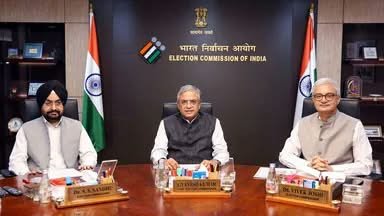
The petition notes that the Election Commission is a multi-member body. Currently, Gyanesh Kumar serves as the Chief Election Commissioner, while Sukhbir Singh Sandhu and Vivek Joshi are the Election Commissioners. Under the law, if there is no consensus among the three on any issue, the decision must be taken based on a majority. The petition also raises questions regarding the Special Intensive Revision (SIR). It argues that if the Commission did not reach a unanimous decision on this entire process, serious constitutional questions arise.
The petition claims that between October 28, 2025, and August 14, 2026, the two Election Commissioners allegedly registered at least 14 separate objections. These objections concerned actions taken in the name of the Commission without the Election Commission’s approval.
It states that if the powers vested in the Election Commission as a multi-member body under the Constitution and the 2023 Act are exercised by a single individual without the participation of other members, it raises serious constitutional questions.
According to the petition, crucial decisions such as who is included in the electoral roll and, consequently, who is eligible to vote must be made by the constitutional body established by the Constitution for this specific purpose.
The petition seeks the issuance of a writ of Quo Warranto. Quo Warranto is a judicial writ literally meaning “by what authority ?” Through this, the Chief Election Commissioner is called upon to explain the authority under which he has exercised, and continues to exercise, the Election Commission’s collective decision-making power on an individual basis.
The petition further asserts that if it is found that the CEC exercised collective authority without a decision by the Commission as required under Section 18 of the 2023 Act then such exercise of authority should be declared illegal.
Additionally, the petition seeks to have the Special Intensive Revision (SIR) and all associated steps, decisions, directives, and consequential actions declared void ab initio (null and void from the very beginning) and without legal authority.
Report – Abhijit Tushar Bhatt(Political Editor)