

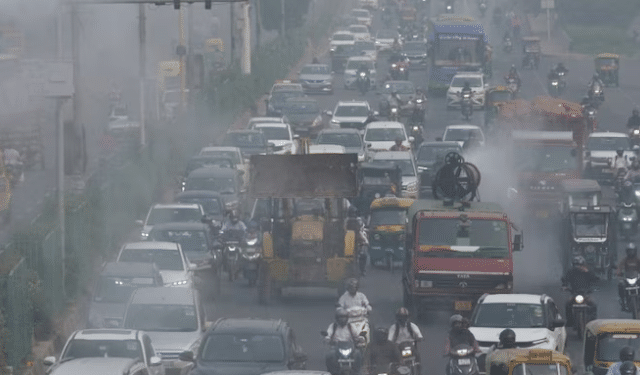
New Delhi : The Supreme Court has proposed stringent measures to tackle Delhi’s recurring air pollution, suggesting that only vehicles meeting BS-VI emission standards should be permitted to operate in the national capital, with the possibility of extending the restriction across the National Capital Region (NCR).
The proposal came during a hearing on Monday in the ongoing suo motu case concerning the worsening air quality in Delhi-NCR. A bench headed by Chief Justice of India Surya Kant, along with Justices Joymalya Bagchi and V. Mohana, observed that the comparatively better air quality recorded in Delhi this November should not be mistaken for a permanent improvement.
Responding to submissions by Additional Solicitor General Aishwarya Bhati regarding enforcement measures undertaken by the Commission for Air Quality Management (CAQM), the court remarked that favourable weather conditions and northwesterly winds had largely helped prevent the air quality from entering the ‘severe’ category.
Focusing on vehicular emissions, which contribute approximately 21.5% of Delhi’s PM2.5 pollution, the bench proposed a five-year strategy to restrict the entry of commercial vehicles into the capital while ensuring that essential supplies remain uninterrupted.
As part of the suggested plan, the court discussed establishing large warehousing facilities along Delhi’s borders. Heavy commercial trucks could unload vegetables, fruits and other essential commodities at these designated hubs, from where battery-operated or other non-polluting vehicles would transport the goods into the city.
At present, Delhi follows seasonal restrictions from November 1 to January 31, prohibiting the entry of certain outside-registered commercial vehicles meeting BS-IV or older emission standards. Enforcement is supported by border inspections and Automatic Number Plate Recognition (ANPR) cameras.
The Supreme Court has also sought status reports from neighbouring states and indicated that it will consider additional immediate and long-term measures to address the pollution crisis across Delhi-NCR.