
 newspop

No Photograph, No Painting : Just a 315,000-Year-Old Skull and Modern Science
SPECIAL STORY : Imagine looking into the face of a human who lived more than 3 lakh years ago. A remarkable scientific reconstruction is offering people a rare glimpse into the appearance of one of our ancient ancestors, using a fossil skull discovered decades ago in Morocco. The story goes back to the 1960s, when workers carrying out mining activities at Jebel Irhoud in Morocco, North Africa, uncovered human remains, including a remarkably important skull.
At first, scientists believed the remains could be linked to Neanderthals, but subsequent research completely changed the understanding of the discovery. A major reassessment published in 2017 placed the Jebel Irhoud fossils at around 315,000 years old and identified them as belonging to early Homo sapiens, making them among the oldest known fossils associated with our species. Now, using sophisticated 3D digital reconstruction techniques, researchers have been able to create a scientific approximation of what the face of one of these ancient humans may have looked like.
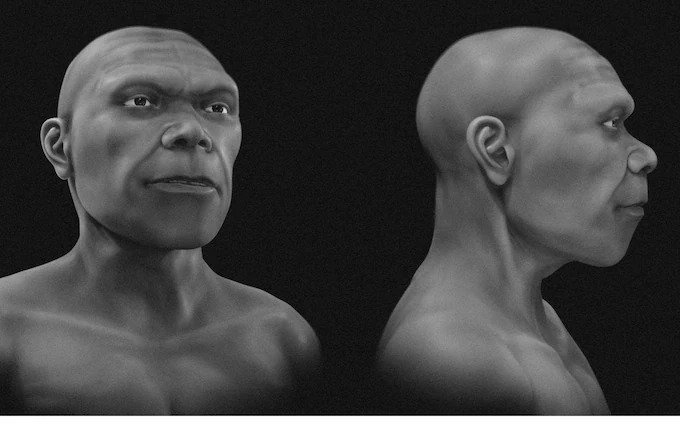
Experts used a three-dimensional model of the Jebel Irhoud skull and reconstructed the facial region by estimating the placement of muscles and other soft tissues based on anatomical comparisons. The resulting face provides a fascinating picture of a human who lived at a time when our species was still in the early stages of its evolutionary history.
A Face That Looks Surprisingly Human
One of the most striking aspects of the reconstruction is how familiar some of its features appear. Although the individual lived roughly 315,000 years ago, the reconstructed face shares several broad characteristics with people today. Scientists suggest that the ancient individual may have had a relatively broad nose, a stronger or more robust jaw and differences in the overall shape of the skull compared with modern humans.
Yet the reconstruction also demonstrates that early Homo sapiens were not completely different-looking creatures. Their anatomy already contained many characteristics associated with modern humans. This is particularly significant because the Jebel Irhoud fossils provide evidence that important aspects of the modern human body plan were already present in Africa hundreds of thousands of years ago.
How Did Scientists Recreate a Face From a Skull ?
The process is far more complicated than simply placing a digital face over an ancient skull. Researchers first created a 3D representation of the fossil, allowing them to study the surviving bones and their proportions. They then used knowledge of human anatomy and comparative information from modern populations to estimate the thickness and position of facial tissues, muscles and other structures.
Digital modelling makes it possible to reconstruct the face without physically altering the fragile fossil itself. The process can therefore provide a visual interpretation while preserving the original archaeological material. However, scientists stress that such reconstructions are approximations, because soft tissues such as skin, hair and facial details do not survive in an ordinary fossilised skull.
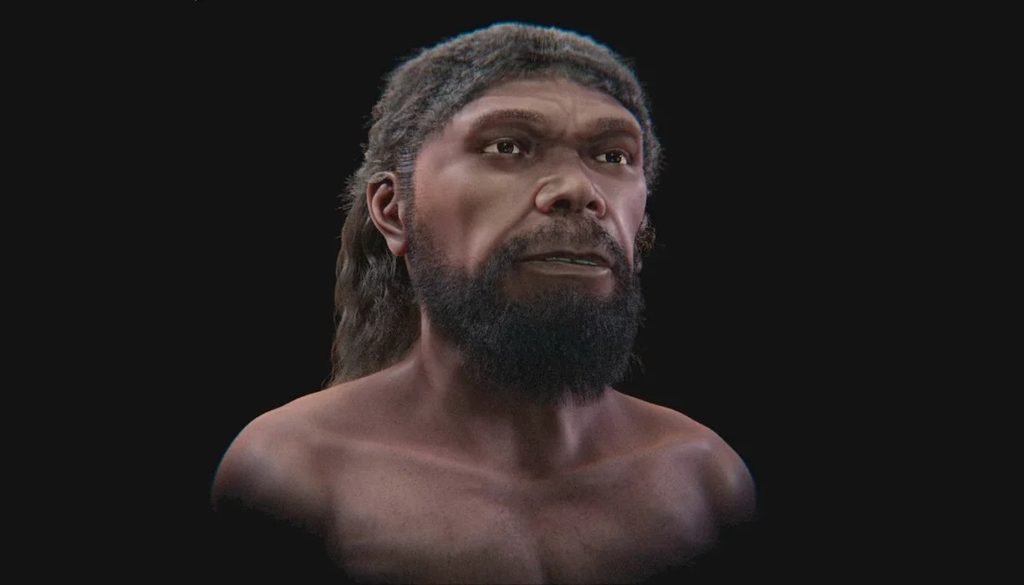
Why Does the Reconstruction Show Dark Skin and Black Hair ?
The appearance of darker skin and black hair in some versions of the reconstruction has also attracted attention. But there is an important scientific limitation: a skull cannot directly reveal the exact skin colour, eye colour or hair colour of the individual. These features therefore cannot be treated as confirmed facts about this particular ancient person.
Instead, artists and researchers may use evidence from human evolutionary studies, population history and biological comparisons to create a plausible representation. For that reason, the reconstructed image should be understood as a scientific visualisation of a possible appearance not an exact photograph of a person who lived 315,000 years ago.
Jebel Irhoud Changed the Story of Human Evolution
The discovery is important far beyond the appearance of one ancient individual. For many years, researchers debated when and where Homo sapiens first emerged. The Jebel Irhoud fossils helped strengthen evidence that the origins of our species were not confined to one small part of Africa. Instead, the evolution of modern humans appears to have involved populations spread across different regions of the continent over a long period. The fossils also show that some modern human features developed gradually, rather than appearing suddenly in one place or at one precise moment. In other words, human evolution was a long and complex process, involving changes in anatomy and populations over hundreds of thousands of years.

The Ancient Human Was Not Simply a ‘Caveman’
The reconstruction also challenges the popular image of early humans as completely primitive-looking people who bore little resemblance to us. The individual from Jebel Irhoud lived in a world dramatically different from today’s, but their physical form was already recognisably human in many respects. They belonged to a period long before modern cities, written language and today’s technology, yet their biological connection to modern humanity is remarkably clear. The fossil evidence shows just how deep the history of our species goes and how much of the human story remains buried beneath the ground.
A 315,000-Year-Old Window Into Our Past
The Jebel Irhoud remains have become an important part of the scientific record of human evolution. By combining fossil evidence, archaeology, anthropology and digital technology, researchers can now transform ancient bones into visual representations that help the public understand what our distant ancestors may have looked like. But every reconstructed face also carries a reminder of scientific uncertainty: the bones provide evidence, while the final appearance involves informed estimation.
Even so, seeing a possible face emerge from a skull that survived for more than 300,000 years offers a powerful connection between the distant past and humanity today. The face may not be an exact portrait, but it represents something extraordinary the possibility of looking across hundreds of thousands of years and seeing a visual echo of one of the earliest known members of our species.