
 newspop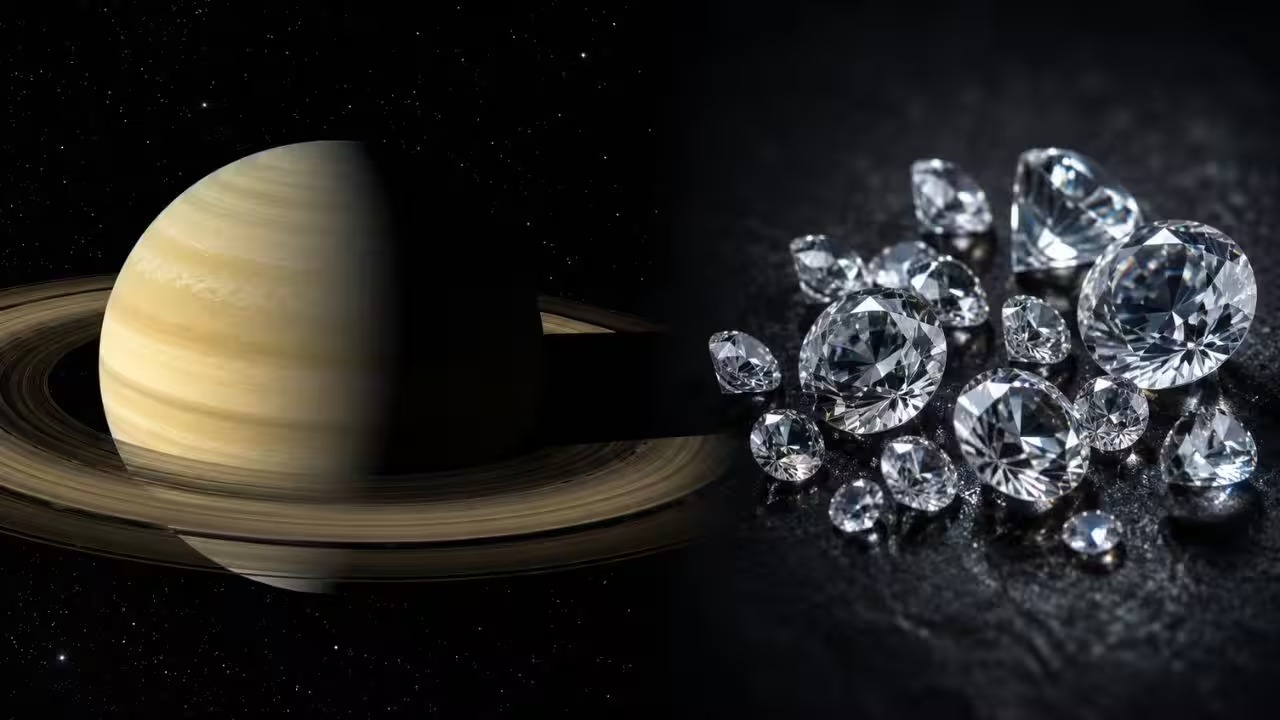
Saturn Produces 1,000 Tonnes of Diamonds Every Year ? Scientists Reveal a Stunning Theory
SPECIAL STORY : Known for its spectacular rings, Saturn has long fascinated astronomers around the world. But scientists believe the giant gas planet may be hiding an even more astonishing secret deep within its atmosphere it could be producing around 1,000 tonnes of diamonds every year.
According to scientific models, Saturn’s atmosphere contains large amounts of methane, which is made up of carbon and hydrogen. During the planet’s intense lightning storms, methane molecules are believed to break apart, leaving behind tiny carbon particles.
As these carbon particles sink deeper into Saturn’s atmosphere, they are subjected to extreme pressure and scorching temperatures. Scientists suggest that the particles first transform into graphite the same form of carbon found in pencil lead and then, under even greater pressure, are converted into solid diamonds.
Some researchers estimate that nearly 1,000 tonnes of diamonds could form annually before sinking further into Saturn’s interior. At even greater depths, where temperatures and pressure become extraordinarily high, these solid diamonds may eventually melt into liquid diamond.
Although no spacecraft has directly observed this remarkable process, laboratory experiments and computer simulations support the possibility that the conditions inside Saturn could make such a transformation feasible.
Scientists from institutions including the University of Wisconsin–Madison and NASA’s Jet Propulsion Laboratory have explained that Saturn’s powerful storm systems may trigger the chemical reactions needed for this process. Lightning can split methane molecules, allowing carbon to accumulate as soot-like particles that gradually descend through the atmosphere.
As the particles travel deeper, increasing pressure changes their structure—from soot to graphite and eventually into diamonds. Researchers say Saturn’s immense size and unique atmospheric conditions make this extraordinary phenomenon scientifically plausible.
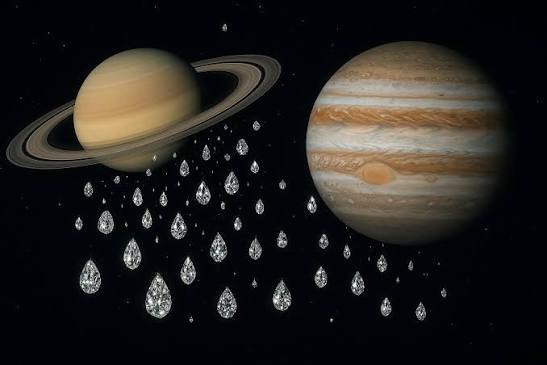
While the idea of “diamond rain” on Saturn remains a scientific hypothesis rather than a directly observed fact, it continues to captivate researchers and space enthusiasts alike. Future space missions and advanced observations may help confirm whether the ringed giant truly hides one of the universe’s most dazzling natural wonders.