

 newspop
With the Semiconductor 2.0 Mission, India is now poised to become the world’s new chip hub
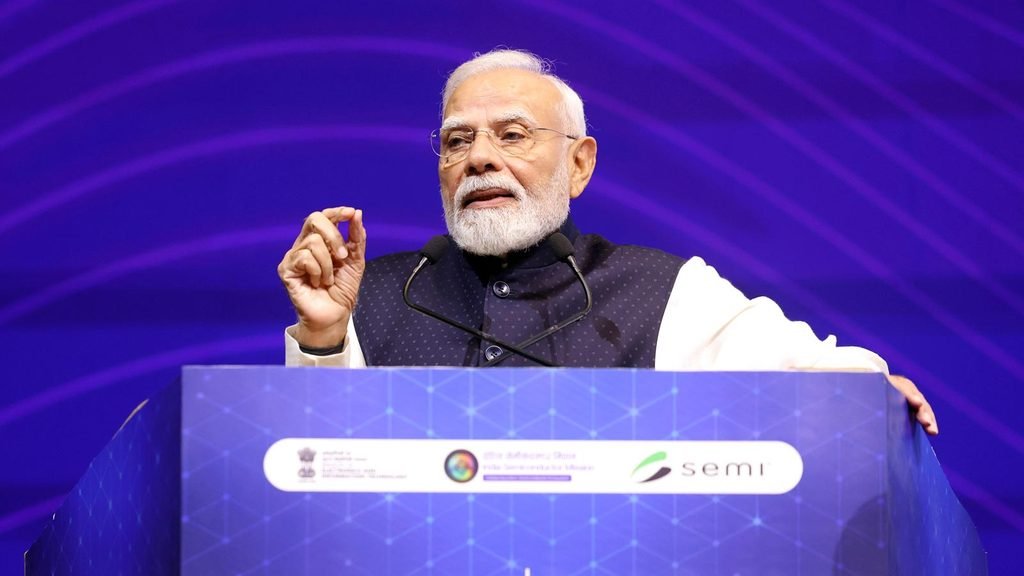
New Delhi : Until now, whenever the conversation turned to electronics and microchips, the world’s gaze would invariably shift to China, Taiwan, or South Korea. But now, the game is set to change. PM Modi inaugurated the fifth edition of ‘Semicon India 2026’ with great fanfare and made a major announcement regarding India’s ambition to become a global semiconductor hub.
Organized around the theme ‘Silicon to Systems : Building the Ecosystem,’ this three-day global event has made it clear that India will no longer be dependent on others. With the launch of the Semiconductor 2.0 Mission backed by a massive budget of ₹1.27 lakh crore India has issued a direct challenge to the ‘Dragon’s’ dominance in the tech sector.
Just a day before the formal inauguration of Semicon India 2026, PM Modi held a high-profile roundtable meeting with the CEOs of the world’s most powerful tech companies. Global heads of industry giants such as Micron, ASML, Infineon, Applied Materials, Intel, AMD, and Tata Electronics attended this meeting. During the closed-door discussion, PM Modi told global leaders that India possesses a unique combination of talent, a vast market, and stable policies strengths unmatched anywhere else in the world.

He extended an open invitation to these global giants to move beyond mere assembly operations in India and instead undertake research, design, and full-scale manufacturing within the country.
For years, China has held sway over the world by leveraging its low-cost manufacturing capabilities and a near-monopoly on electronics supplies. According to a report, India’s ₹1.27 lakh crore ‘Semiconductor Mission 2.0’ is designed to eliminate this dependency and directly challenge China’s dominance. The primary focus of this new phase extends beyond mere chip assembly; it aims to secure indigenous chip design and its associated Intellectual Property (IP) within India.
This means that Indian minds will determine the design and production of chips used in future smartphones, AI devices, smart vehicles, and defense equipment. Once the key to this technology rests in India’s hands, China’s dominance will inevitably crumble. From laptops to missile technology, and from AI models to 5G/6G networks, the heart and brain of every modern gadget is a tiny silicon chip.
Under the ‘Semicon 2.0’ initiative, the government is fostering the domestic development of chips, Systems-on-Chip (SoCs), and modules that are critical to national security and infrastructure. The government is making expensive Electronic Design Automation (EDA) tools and fabrication services costing crores of rupees available to the country’s brilliant tech startups and design companies on highly favorable terms, thereby enabling India to build its own technological intellectual property.
Transforming a nation into a semiconductor superpower requires a comprehensive support system, encompassing specialized chemicals, gases, silicon wafers, and high-tech testing laboratories. The Government of India has put in place robust measures to establish this entire ecosystem domestically. Under the new policy, capital support of up to 40% is being provided for setting up large silicon wafer fabrication plants (fabs). Additionally, companies establishing facilities for semiconductor equipment, photomasks, substrates, and testing units will receive substantial subsidies of up to 30%. A direct outcome of this will be global companies shifting their operations from China to India.
The greatest strength of this entire mission lies in our country’s young talent. IT Minister Ashwini Vaishnaw stated that the target was to train 85,000 semiconductor engineers over a span of 10 years a goal Indian youth achieved in a record four years. Now, the government has set an ambitious target to train an additional one lakh (100,000) engineers and researchers. Remarkably, college students from the country’s Tier-2 and Tier-3 cities have already designed over 250 microchips themselves. This entire ‘Silicon Revolution’ is set to generate 50,000 to 60,000 high-paying direct jobs and lakhs of indirect employment opportunities in the coming years.
When global supply chains collapsed during the COVID-19 pandemic, the world realized the risks associated with relying on just one or two countries. PM Modi’s ‘Silicon Clarion Call’ embodies the vision to eliminate this risk permanently. From the Tata Group’s fabrication plant to Micron’s testing units, the new ecosystem emerging in India will not only make the nation self-reliant but also establish India as a true ‘Tech Titan’ on the global map.
Report – Abhijit Tushar Bhatt (Political Editor)



 Mudasir Maqbool