
 newspop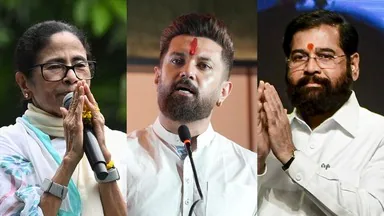
The Election Commission has not yet issued a final order in the Trinamool Congress case either
New Delhi : Mamata Banerjee lost West Bengal in May, and in September, she had to relinquish the Trinamool Congress name and the ‘two flowers’ election symbol. However, the Arup Roy faction will not be able to use them either; the main name and symbol have been frozen via an interim order. The situation could change in the future. The question arises: how did the Election Commission award the name and symbol to the faction led by Eknath Shinde—now the Deputy Chief Minister of Maharashtra—when the Shiv Sena split in 2022?
How does the Election Commission decide when two factions emerge within a single party, with both claiming to be the genuine party? The Election Symbols (Reservation and Allotment) Order, 1968, is the instrument the Commission uses to navigate the process of determining which faction gets the party’s election symbol, flag, and name. Section 15 of this order is particularly crucial.
According to Section 15 of this law: “When the Commission is satisfied from the information available to it that there are rival sections or groups of a recognized political party, each claiming to be that party, the Commission may, after considering all available facts and circumstances and hearing the representatives of the factions or groups and other relevant persons, decide that one such faction or group is that recognized political party or that none of them is that party. The decision of the Commission shall be binding on all such factions or groups.”
In simpler terms, an expert explains that the Election Commission will focus on the organizational strength—specifically the number of members—within both factions. Additionally, the numerical strength of MLAs and MPs will play a pivotal role. Both sides are required to submit this information via an affidavit. Former Election Commissioner S.Y. Quraishi explains that the Commission makes decisions based on the ‘rule of majority.’ He stated that the Election Commission examines which faction commands greater support among MPs, MLAs, and the organization itself.
Former Election Commissioners explain that to determine which side holds greater organizational support, a count is taken of all party office-bearers and individuals authorized to elect the party president. The party is required to submit an affidavit regarding this, after which the Commission verifies the signatures. A decision on which faction gets the party symbol is reached only after this entire process is concluded.
However, in the case of the split within the Shiv Sena, the Election Commission did not immediately recognize the Shinde faction as the main party. Initially, the ‘Shiv Sena’ name and the ‘Bow and Arrow’ symbol were frozen, and both factions were asked to select separate names and symbols. The Shinde faction secured these rights in 2023.
The Commission stated that its decision was based on a majority test, noting that the MLAs supporting the Shinde faction had garnered approximately 76 percent of the votes in the 2019 Assembly elections, whereas the figure stood at 23.5 percent for the Uddhav Thackeray faction. A total of 55 candidates from the undivided Shiv Sena had won in that election. In its 78-page order, the Commission declared, “The name ‘Shiv Sena’ and the party’s election symbol ‘Bow and Arrow’ shall remain with the petitioner faction”—referring to the Shinde faction. Before the Election Commission, the Shinde faction demonstrated that it enjoyed the support of 40 MLAs and 13 out of the 18 MPs. Additionally, the factions had submitted affidavits to the Commission containing signatures to substantiate their claims regarding organizational support.
It is noteworthy that, in the case of the TMC, only an interim order has been issued so far. While it is possible that one faction might eventually secure the party’s main name and symbol, this is not guaranteed. The interim order states, “After duly considering all information on record… the Commission is of the view that there are two rival factions within the Trinamool Congress—one led by Mamata Banerjee and the other helmed by Arup Roy.”
According to the interim order, “Since both factions are now claiming to be the ‘real’ Trinamool Congress, the Commission is required to take a definitive decision on the matter under Paragraph 15 of the Election Symbols (Reservation and Allotment) Order, 1968.” The Commission clarified that this step was taken in light of the ongoing by-elections, and the current interim order will remain in effect until the matter is finally resolved.
Significantly, by-elections for the Nandigram and Rejinagar assembly seats are scheduled for October 6. Both factions have already announced their respective candidates for these seats.
In 2021, shortly after the demise of Ram Vilas Paswan, reports of infighting within the Lok Janshakti Party—which used the ‘hut’ symbol—intensified. The dispute over the party arose between Paswan’s son (and sitting MP) Chirag and his brother Pashupati Kumar Paras; both claimed leadership of the genuine party.
On October 2, 2021, the Election Commission issued an interim order freezing the party’s name and symbol, prohibiting either faction from using them. Two days later, on October 5, new names and symbols were allotted. Notably, by-elections for two seats in Bihar were scheduled to take place just 28 days later, on October 30, 2021—a situation mirroring the upcoming by-elections for two seats in Bengal.
The Election Commission permitted both the Chirag and Pashupati factions to retain “Lok Janshakti Party” in their names and allotted them new symbols. Chirag secured the ‘helicopter’ symbol and the name ‘Lok Jan-Shakti Party (Ram Vilas),’ while his uncle Paras received the ‘sewing machine’ symbol and the name ‘Rashtriya Lok Janshakti Party.’ Currently, both factions have retained their respective new names and identities. In the 2024 Lok Sabha elections, Chirag won the Hajipur seat using the ‘helicopter’ symbol and his new party name; he subsequently joined the NDA and became a minister.
Report – Abhijit Tushar Bhatt (Political Editor)


 Mudasir Maqbool