


THE EXTRAORDINARY STORY BEHIND INDIA’S ICONIC MONUMENT
What if we told you that one of the world’s most beautiful monuments took nearly 22 years to complete, involved around 20,000 to 22,000 skilled artisans and workers, and required an extraordinary combination of rare marble, precious stones and master craftsmanship? The Taj Mahal, one of India’s most celebrated architectural wonders and a UNESCO World Heritage Site, has fascinated the world for centuries.
Built by Mughal Emperor Shah Jahan in memory of his beloved wife Mumtaz Mahal, this magnificent white-marble monument stands on the banks of the Yamuna River in Agra, Uttar Pradesh. Its construction began around 1631–32, following Mumtaz Mahal’s death in 1631. The main mausoleum was completed in 1648, while the entire architectural complex, including the mosque, guest house, grand entrance gate and beautifully designed gardens, was completed by 1653. This means the complete project took approximately 22 years.

But how much did Shah Jahan actually spend on building this architectural masterpiece? Surprisingly, there is no universally accepted or conclusively established figure for its original construction cost. Historical accounts and later estimates mention different amounts. Some records refer to an initial expenditure of around five million rupees, while other historical estimates suggest a much higher overall cost.
A figure of approximately 40 million rupees has also appeared in historical discussions and official reports, but it should not be treated as a definitively verified final bill. The construction involved an enormous workforce of approximately 20,000 to 22,000 artisans, craftsmen and labourers, including masons, stone cutters, sculptors, calligraphers, painters and specialists in decorative stonework. Skilled workers were brought from different parts of India and beyond to contribute their expertise to the project.
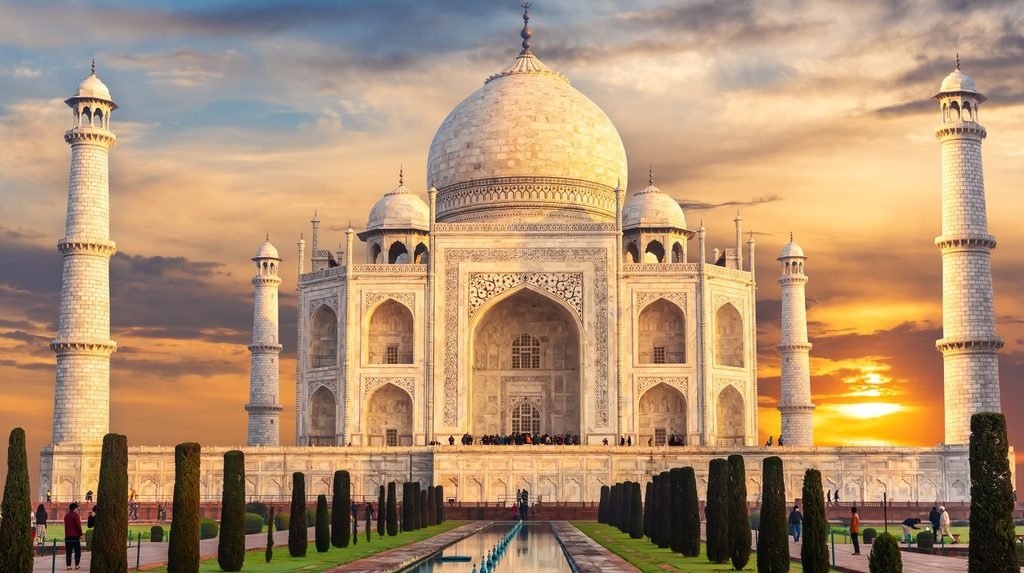
The materials used in the Taj Mahal were equally remarkable. The main structure was built using brilliant white Makrana marble brought from Rajasthan. Its walls and decorative surfaces were enhanced with intricate floral patterns, detailed carvings and inlay work using precious and semi-precious stones.
Historical accounts mention the use of materials sourced from different regions, including jade, crystal, turquoise, lapis lazuli, sapphire and other decorative stones. The monument’s beautiful calligraphy, symmetrical architecture, massive central dome, four elegant minarets and elaborate garden layout reflect the extraordinary engineering and artistic skills of that period. The complex was designed around the principles of Mughal architecture, combining Persian, Islamic and Indian artistic influences.
Now comes another fascinating question: How much would it cost to build the Taj Mahal today? There is no official government estimate for reconstructing the monument in modern times. However, several media reports have suggested that recreating a structure of comparable scale and craftsmanship could cost approximately ₹5,280 crore to ₹8,000 crore. These are indicative estimates rather than verified construction budgets, as the cost would depend on the quality of materials, availability of specialised artisans, traditional construction techniques and the complexity of the decorative work.

Interestingly, the Taj Mahal is not just a historical monument; it is also one of India’s biggest tourism attractions and an important source of revenue. Millions of domestic and international visitors travel to Agra every year to witness its beauty. According to figures attributed to the Archaeological Survey of India (ASI), the Taj Mahal generated approximately ₹99.77 crore through ticket sales during the financial year 2024–25, compared with around ₹98.55 crore in 2023–24. Its popularity continues to contribute significantly to India’s tourism sector and cultural heritage recognition.
From the extraordinary 22-year construction journey and the contribution of thousands of skilled workers to its priceless marble craftsmanship and impressive tourism revenue, the Taj Mahal remains far more than a monument. It is a remarkable chapter in India’s architectural history and a lasting symbol of artistic excellence that continues to attract admiration from across the globe even after nearly four centuries.