

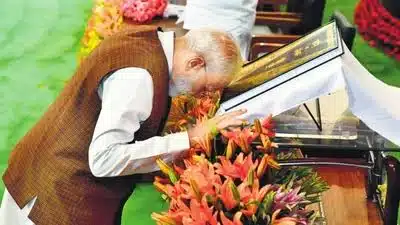
New Delhi : Prime Minister Narendra Modi on Thursday called for strengthening the connection between the Constitution and the everyday lives of citizens, stating that its spirit must extend beyond Parliament and the judiciary to become part of India’s collective consciousness, particularly among the youth.
In an opinion piece published in Hindustan Times on Constitution Day, Modi paid tribute to Dr. Rajendra Prasad, Dr. B.R. Ambedkar and the members of the Constituent Assembly, which adopted the Indian Constitution on November 26, 1949.
The Prime Minister highlighted the Constitution’s role in creating equal opportunities, saying it has enabled individuals from modest backgrounds to rise to positions of great responsibility, regardless of their circumstances of birth.
Focus on Social Justice and Welfare
Describing the Constitution as a foundation for social and economic transformation, Modi referred to a World Bank report that noted nearly 50 crore Indians had moved out of poverty. He highlighted government initiatives such as PM Awas Yojana, Ujjwala Yojana, Ayushman Bharat, MUDRA and PM-SVANidhi, saying these programmes have contributed to dignity, financial inclusion, healthcare and improved living standards.
He also cited the expansion of digital services, particularly UPI, as an example of technology supporting financial accessibility and inclusive development.
Constitutional Reforms and Citizen Duties
Highlighting major constitutional changes during his government’s tenure, Modi referred to the 101st Amendment introducing GST, the 102nd Amendment granting constitutional status to the National Commission for Backward Classes and the 103rd Amendment providing reservation for Economically Weaker Sections.
He also mentioned the availability of an updated Constitution in all 22 languages listed in the Eighth Schedule and the replacement of colonial-era criminal laws with the Bharatiya Nyaya Sanhita.
Emphasising the importance of Kartavya (duties), the Prime Minister pointed to initiatives such as Swachh Bharat and environmental conservation, arguing that citizens’ responsibilities are equally important in strengthening democracy.
Modi Criticises Previous Governments and Opposition
The Prime Minister also raised concerns over what he described as the misuse of constitutional provisions by previous governments. Referring to the First Amendment of 1951, the 42nd Amendment during the Emergency, and the 38th and 39th Amendments, he questioned decisions that, according to him, weakened constitutional principles.
He further criticised the repeated use of Article 356 to dismiss elected state governments, which he said had happened nearly 100 times.
Referring to Jammu and Kashmir, Modi described the abrogation of Articles 370 and 35A in 2019 as a significant step towards extending constitutional rights and provisions to the region.
He also targeted the principal Opposition party over issues concerning OBC reservations, women’s political representation and parliamentary proceedings. Accusing it of obstructing important reforms, he said it had increasingly become an “Avrodh Paksh” (obstructionist party) rather than a constructive “Virodh Paksh” (Opposition).
Call for a Developed India by 2047
Concluding his message, Modi urged citizens, particularly young Indians, to embrace constitutional values and contribute towards building a developed nation by 2047.
He stressed that the vision of Viksit Bharat requires an approach guided by “India First” in thought and “Kartavya” in action, adding that the Constitution must remain a living force in the lives of every Indian.