 Mudasir Maqbool
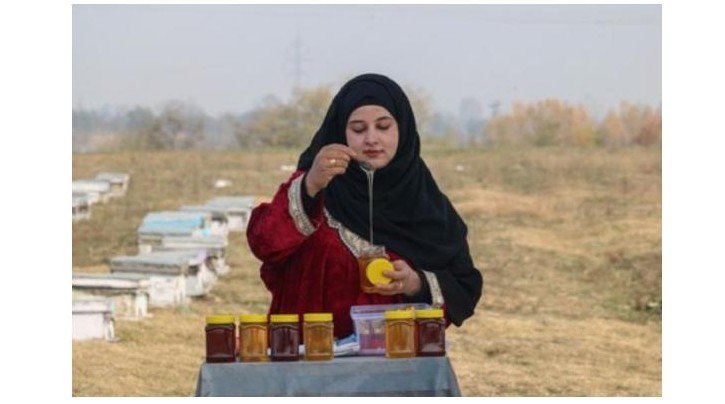
Srinagar, J & K : From watching her father tend bee colonies as a child to managing hundreds of hives herself, Saniya Zehra’s journey reflects how determination, business innovation and a willingness to challenge social conventions can transform a family setback into an entrepreneurial opportunity.
The young entrepreneur from Balhama on the outskirts of Srinagar has carved a niche in Kashmir’s beekeeping sector, a profession traditionally dominated by men. Popularly known as the Bee Queen of Kashmir, Zehra has expanded her family’s ancestral business, developed her own brand and built a direct-to-customer market for honey and other bee-derived products.
Her journey took a decisive turn in 2020, when her father, Gulzar Ahmad Mir, suffered a major loss while transporting bee colonies to warmer regions for the winter. The closure of the national highway stranded vehicles carrying the colonies, and prolonged exposure to cold resulted in the death of around 150 colonies, causing an estimated financial loss of ₹9 lakh. Only about 20 to 40 colonies survived.
The setback left the family contemplating whether to continue the business, which had been a source of livelihood for generations. Zehra, who had aspired to pursue a career in the medical field and was reportedly studying physiotherapy, decided to step in and help revive the enterprise.
Despite initial apprehensions and social discouragement, she took charge of the business and began with 35 bee colonies. She also drew on her martial arts training, which had helped develop the physical endurance and confidence required to work with beehives and manage the demanding routine of beekeeping.
Challenging Gender Barriers
Zehra faced resistance from people who considered the profession unsuitable for women because of the physical labour involved, the risk of bee stings and the need to travel with colonies. She, however, chose to challenge those perceptions through her work.
“People say that beekeeping is a man’s job because it involves lifting heavy boxes and staying in forests. But I believe there is no work that a woman cannot do,” she says, emphasising that determination and dedication matter more than gender.
In the years since she began rebuilding the business, Zehra has expanded her operations to around 600–650 bee colonies. Her experience has taken her beyond Kashmir, as seasonal migration is essential to sustaining colonies and maintaining honey production during the Valley’s harsh winters.
Between November and February, when low temperatures and snowfall restrict beekeeping activities in Kashmir, colonies are moved to warmer regions, including Rajasthan and Punjab, where favourable climatic conditions and flowering plants provide opportunities for continued production.
The seasonal movement, however, brings its own challenges, including transportation costs, logistics and the need to ensure the survival of the colonies. Zehra says the availability of suitable flowering plants is crucial to maintaining bee health and honey production.
She has also expressed concern over the decline of acacia trees, an important source of nectar for bees. The loss of such vegetation can affect honey production and quality, forcing beekeepers to travel farther in search of suitable forage.

Building Her Own Brand
One of Zehra’s key business decisions was to move away from the traditional system of selling honey through intermediaries. She says the arrangement often left producers with low returns, while concerns over adulteration and misleading claims about purity made it difficult for genuine honey to command the value it deserved.
She began marketing her products independently, using social media and direct customer outreach to establish a market beyond Kashmir. Her business operates under the brand name Kashmir Pure Organics, through which she sells honey and has diversified into products made from bee-derived and other natural ingredients.
Her product range includes cosmetics such as soaps, face creams and hair oils, while her business activities also extend to other bee products, including pollen and royal jelly.
By developing a direct relationship with customers, Zehra has sought to retain greater control over marketing, pricing and the identity of her products. Her brand has reached customers outside Jammu and Kashmir, with reports of sales extending to international markets, including Saudi Arabia, Dubai and Qatar.
She has also used social media to raise awareness about honey adulteration and the importance of product authenticity. However, determining the purity of honey can be difficult without access to reliable testing facilities, making quality verification and consumer awareness important concerns for beekeepers and buyers alike.
Zehra’s experience illustrates how value addition and direct marketing can help small producers explore opportunities beyond the conventional sale of raw agricultural products.
Challenges Facing Kashmir’s Beekeepers
Despite the expansion of her business, Zehra’s journey highlights the difficulties faced by beekeepers in Kashmir. Seasonal migration, unpredictable weather, transportation disruptions and the availability of flowering vegetation all influence the survival of colonies and the quantity of honey produced.
Honey quality also depends on the nectar collected by bees, with different floral sources producing honey with distinct colours, flavours and characteristics. For beekeepers, maintaining healthy colonies and access to suitable forage is therefore essential to sustaining production.
Zehra’s experience also points to the wider challenges facing women entrepreneurs in rural and semi-urban areas, where entering a non-traditional profession can invite scrutiny and discourage those seeking to establish independent businesses.
For her, persistence has been central to overcoming these barriers. Instead of abandoning the family enterprise after a devastating financial setback, she used the opportunity to introduce a different approach to production, marketing and product diversification.
Recognition and Inspiration
Her work has brought her recognition, including the Uttam Bharat Award 2025, according to accounts of her entrepreneurial journey. She has also reportedly received a Certificate of Appreciation from the Srinagar district administration for her contribution to entrepreneurship.
Today, Zehra’s journey from a small number of surviving bee colonies to an enterprise managing hundreds of hives has become an example of women’s participation in agriculture and allied sectors in Jammu and Kashmir.
Her story is not merely about honey production. It is also about rebuilding a traditional family occupation, creating a distinct business identity and demonstrating that women can take leadership roles in professions long considered the preserve of men.
For aspiring entrepreneurs, her experience offers a practical lesson: setbacks need not mark the end of a business if they are met with persistence, adaptability and a willingness to explore new ways of working.



 newspop