
 newspop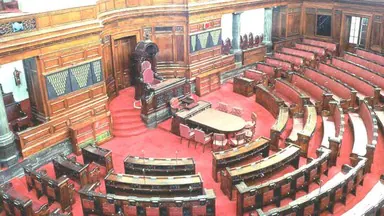
Contest likely to be intriguing given that most seats are from Uttar Pradesh
New Delhi : Rajya Sabha elections are on the horizon once again, driven by the scheduled retirement of 10 MPs in November. Notably, nine of these seats are in Uttar Pradesh, where assembly elections are due in 2027 while one is from Uttarakhand. These elections are taking place amidst speculation regarding a Union Cabinet reshuffle, although the NDA (National Democratic Alliance) has made no official statement on the matter.
While election dates have not yet been announced, it is anticipated that the polls could be held in mid-October.
Currently, the Upper House of Parliament has 243 members. In terms of numbers, the major parties stand as follows: the Bharatiya Janata Party (BJP) has 116 members, the Congress has 30, the Trinamool Congress has 9, and the Dravida Munnetra Kazhagam (DMK) has 8 ; additionally, there are 7 nominated members. If the NDA’s strength is tallied, the figure exceeds 150, yet the alliance remains short of a two-thirds majority. Meanwhile, the opposition INDIA alliance holds 64 seats, a figure affected by the fact that the DMK (with 8 MPs) and the AAP (with 3 MPs) have distanced themselves from the alliance.
A total of 10 MPs are set to retire on November 25. This group includes 8 MPs from the BJP, one from the Bahujan Samaj Party (BSP), and one from the Samajwadi Party (SP). With the exception of Naresh Bansal from Uttarakhand, all represent Uttar Pradesh. It is believed that the increase in SP’s MLA count following the UP assembly elections could benefit the party in the Upper House, whereas the ruling BJP might see a reduction in its seat tally in the state. Retiring members from the BJP include Brijlal, Seema Dwivedi, Chandraprabha, Hardeep Singh Puri, Neeraj Shekhar, Arun Singh, and BL Verma. Meanwhile, Ram Gopal Yadav (SP) and Ramji (BSP’s lone MP) are retiring. Notably, if the BSP does not secure support from another political party, its representation in the Rajya Sabha could drop to zero. This is because the party currently has no members in the state assembly, which has over 400 seats; its sole MLA, Umashankar Singh, had passed away.
In terms of the number of assembly seats, India’s largest state currently has 397 MLAs. The BJP is the largest party with 256 members, followed by the SP with 101 MLAs, led by Akhilesh Yadav. Other parties include Apna Dal (Sonelal) with 13 MLAs, Rashtriya Lok Dal (9), Suheldev Bharatiya Samaj Party/Subhaspa (6), Nishad Party/Nirbal Indian Shoshit Hamara Aam Dal (5), Jansatta Dal Loktantrik (2), and the Congress (2), alongside 3 independent MLAs.
The NDA alliance comprising Apna Dal (Sonelal), RLD, Subhaspa, and the Nishad Party reaches a tally of 289 seats. With the support of Jansatta Dal Loktantrik, this figure rises to 290.
Rajya Sabha elections are conducted using the Single Transferable Vote (STV) system. An MLA does not simply cast a vote for a single MP; instead, they list candidates in order of preference. Given the current number of MLAs in Uttar Pradesh, a candidate needs at least 40 votes to win a Rajya Sabha seat. There is a specific formula for this calculation.
For instance, if 397 MLAs in UP are electing MPs for 9 Rajya Sabha seats, a winner must secure votes based on the formula: (Total MLAs / (Total Candidates + 1)) + 1. Calculating this for UP—397 divided by 10 plus 1 yields a result of 40.7. Thus, a candidate would need to meet a quota of 40.7 votes.
With the current support base, the NDA can get 7 Rajya Sabha MPs elected. Meanwhile, the SP could gain one seat, enabling the party to send two members to the Upper House. Even after this, both parties would still have surplus votes.
Report – Abhijit Tushar Bhatt (Political Editor)


 Mudasir Maqbool