


HE LIFTED A WARRIOR INTO THE SKY AND THREW HIM INTO THE SEA : WHO WAS AKVAN ?
A demon who could change his appearance, deceive even the mightiest warrior and throw him into the sea. This is not a scene from a modern fantasy film, but a centuries-old legend from Persian mythology.
Interestingly, the name of Cyclone Akvan, proposed by Iran, is connected to this mysterious and powerful mythical character from one of Persia’s greatest literary epics, the Shahnameh. Written by the legendary Persian poet Ferdowsi, the Shahnameh, also known as the Book of Kings, is a celebrated epic filled with stories of mighty warriors, kings, supernatural creatures, battles and extraordinary adventures. Among its fascinating characters is Akvan-e Div, a deceptive and powerful demon whose story revolves around one of the most famous heroes of the epic, Rustam.

Akvan was no ordinary mythical creature. According to the legend, he possessed extraordinary strength and the ability to disguise himself, making it difficult for others to recognise his true identity. In one episode, Akvan repeatedly creates trouble, and the mighty warrior Rustam sets out to confront him.
However, the demon uses deception rather than direct confrontation to gain an advantage. One day, when Rustam falls asleep, Akvan seizes the opportunity. The demon lifts the ground beneath the sleeping warrior and carries him high into the sky. He then presents Rustam with a seemingly simple but dangerous choice, should he be thrown onto a mountain or into the sea ?

Rustam immediately understands that the demon intends to do the exact opposite of whatever he chooses. Using his intelligence, he asks Akvan to throw him onto the mountain, hoping that the demon will instead choose the sea. Just as Rustam anticipates, Akvan refuses to follow his request and hurls him into the water.
But the demon underestimates the strength and survival skills of the legendary warrior. Rustam manages to escape from the sea, reunites with his faithful horse Rakhsh and eventually confronts and defeats Akvan. The dramatic encounter became one of the memorable episodes in Persian epic literature, illustrating how intelligence and presence of mind can overcome deception and extraordinary power.
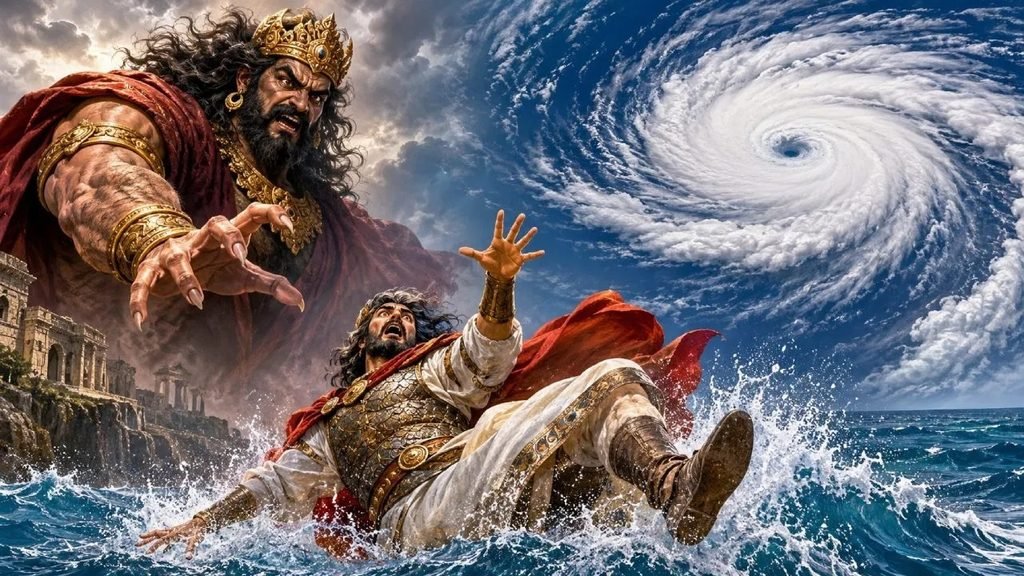
But how is this ancient demon connected to a modern cyclone threatening India’s eastern coastline? The connection lies in the international cyclone-naming system. The name Akvan was proposed by Iran under the regional naming arrangement for tropical cyclones over the North Indian Ocean, which includes the Bay of Bengal and the Arabian Sea. Countries participating in this system submit names in advance, and these are used in a predetermined sequence when qualifying cyclones develop.
The names are chosen from different languages and cultural traditions, which is why some have fascinating historical, literary or mythological associations. Akvan’s connection to Persian mythology gives the cyclone’s name an unusual cultural background. However, the name itself does not indicate the storm’s intensity, danger level, direction or destructive potential. It is simply a name selected from the approved regional list.
From the pages of an ancient Persian epic to the headlines of modern weather reports, the name Akvan has travelled across centuries of history and culture. And behind this cyclone’s unusual name lies a legendary tale of a shape-shifting demon, a clever warrior and a dramatic escape from the sea.