
 newspop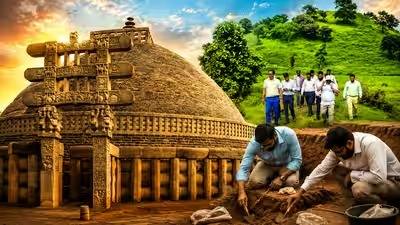
Fresh Excavation Reopens the Mystery of an Ashokan-Era Stupa in Madhya Pradesh
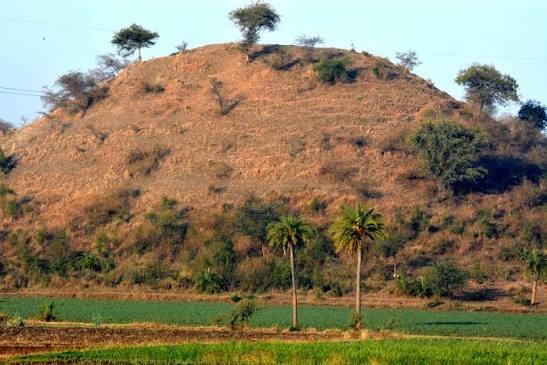
MadhyaPradesh : A centuries-old archaeological mystery is once again attracting attention in Ujjain, Madhya Pradesh, as the state government begins fresh efforts to explore and restore Buddhist monuments believed to be associated with Mauryan emperor Ashoka. The focus is on Vaishya Tekri, a massive ancient mound that has long intrigued historians and archaeologists. The latest excavation could provide valuable clues about Ujjain’s connection with early Buddhism and the Mauryan period but experts caution that many historical claims surrounding the site still need to be scientifically established.
According to academic Peter Skilling, Vaishya Tekri is an enormous structure measuring roughly 350 feet at its base and about 100 feet in height, making it a particularly significant archaeological feature. A smaller mound known as Kumbhar or Kumhar Tekri lies nearby. The two structures have remained relatively undisturbed over the decades, although modern infrastructure has also affected the site.
The first major excavation of Vaishya Tekri was carried out by the Department of Archaeology of the erstwhile Gwalior State in 1938–39. Archaeologists reportedly discovered large bricks and punch-marked coins during the excavation, findings that encouraged researchers to associate the structures with the Mauryan period.
However, historians say the evidence needs to be examined again using modern archaeological methods. Historian Himanshu Prabha Ray has urged caution over immediately identifying Vaishya Tekri as an Ashokan monument. She pointed out that the original excavation report is several decades old and that its interpretation was influenced by earlier historical accounts, including those of British archaeologist Alexander Cunningham.
Ray has stressed that more excavation and investigation are required before drawing definitive conclusions about the site’s origin and its connection with Ashoka. The sheer size of the mound and its reported comparison with the Great Stupa at Sanchi make it an exciting archaeological prospect, but size alone cannot establish its exact date, purpose or historical association.
The renewed excavation could therefore help answer several important questions: Was Vaishya Tekri actually constructed during Ashoka’s reign? Was it a Buddhist stupa, and what role did Ujjain play in the spread of Buddhism? Could archaeological evidence reveal more about Ashoka’s early association with the region?
Ujjain holds an important place in traditions surrounding Ashoka’s early life. Historical accounts associate the young Mauryan prince with the city when he served as its governor before eventually becoming emperor. Traditions also connect his time in Ujjain with Devi, a woman associated with Vidisha, who is traditionally regarded as the mother of his children Mahendra and Sanghamitra.
Yet historians distinguish between literary traditions, later accounts and archaeological evidence. The new excavation at Vaishya Tekri could potentially strengthen or challenge some long-held interpretations, depending on what material is uncovered.
For now, the ancient mound remains a fascinating window into Ujjain’s past. The excavation may not immediately prove every story associated with Ashoka, but it could reveal new evidence about the city, Buddhism and the Mauryan era and perhaps rewrite parts of the historical narrative.