

 newspop
5 Minutes to Escape ! The Hidden Mount Rainier Disaster Scientists Are Watching
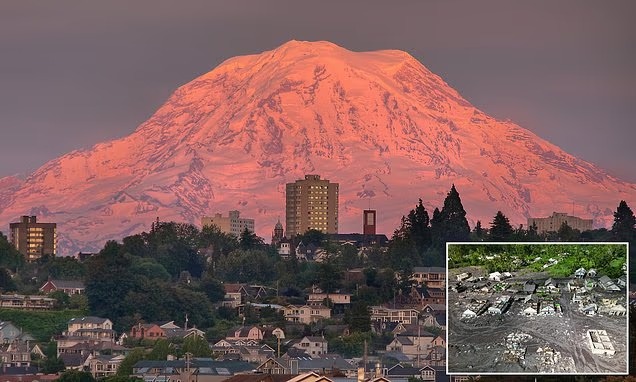
Washington : As the world watches the devastating flash floods in Nepal, another terrifying natural hazard is drawing attention in the United States not from a raging river, but from the heavily ice-covered slopes of Mount Rainier in Washington State. The concern is a phenomenon known as a lahar, a powerful mixture of water, mud, rocks and volcanic debris that can behave like flowing concrete and bury or destroy structures in its path.
The U.S. Geological Survey (USGS) says lahars are among the greatest hazards posed by Mount Rainier to downstream communities, and importantly, a major lahar could occur after a large landslide even without a volcanic eruption. Scientists have identified the volcano’s western flank as potentially vulnerable to a future large-scale collapse, which could send enormous debris flows into river valleys including the Puyallup and Nisqually drainages. Computer models indicate that in a worst-case scenario, a lahar could reach residential areas inside Mount Rainier National Park in about five minutes, while communities farther downstream could be reached in roughly 15 to 60 minutes. Mount Rainier rises to 4,392 metres (14,410 feet) and is covered by extensive snow and ice, while parts of its upper slopes contain weak, water-rich volcanic rock conditions that can make landslides particularly dangerous. If a huge mass of rock and ice collapses, the material could mix with meltwater and race down valleys at extraordinary speed.
Past lahars at Mount Rainier have travelled as fast as 70–80 km/h and, in confined valleys, have reached depths of up to about 150 metres, according to the USGS. The danger is not merely theoretical: geological evidence shows that large lahars from Mount Rainier have reached the densely populated Puget Lowlands in the past, and the USGS says more than 90,000 people live in areas that could be affected by a future large lahar. One of the most striking examples is the Electron Mudflow, around 1500 AD, which was triggered by a large landslide without evidence of an accompanying eruption. While there is no indication that Mount Rainier is currently preparing to erupt, the volcano remains a major hazard because of the enormous amount of ice and unstable material on its slopes.
The USGS has therefore developed lahar-monitoring and warning systems designed to detect the ground vibrations produced by rapidly moving flows and alert emergency officials. The warning from scientists is clear: the immediate threat is not that Mount Rainier is about to erupt, but that a sudden collapse could unleash a fast-moving wall of mud, water, rocks and debris with very little time for evacuation. For communities living downstream, minutes could make the difference between escape and catastrophe.