
 newspop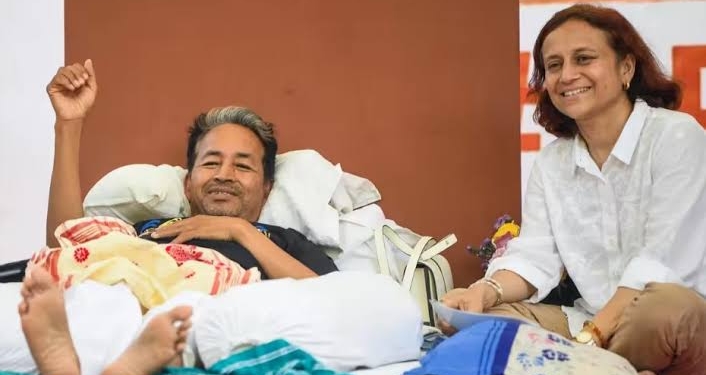
New Delhi : The Delhi High Court on Sunday refused to grant immediate relief on a plea seeking activist Sonam Wangchuk’s transfer from Safdarjung Hospital to a private medical facility, directing authorities to submit an updated health status report within three days.
Hearing a petition filed by Wangchuk’s wife, Gitanjali J. Angmo, Justice Mini Pushkarna observed that there was no need for an interim order at this stage, noting that Wangchuk’s family has been allowed to meet him and that his condition is under continuous medical supervision.
The court remarked that it must consider the “larger picture” before issuing any directions regarding his hospitalisation. It also recorded that Wangchuk is not under detention, and that his wife, brother and brother-in-law have been given access to him, with a separate room arranged for the family inside the hospital.Emphasising that “every life is precious,” the High Court sought a detailed medical report from the authorities and scheduled the next hearing for July 24.
In her petition, Angmo sought permission to move Wangchuk to a private hospital, claiming she had lost faith in the treatment being provided at Safdarjung Hospital. Senior advocate Kapil Sibal, appearing for her, argued that Wangchuk’s personal doctors and legal team were not being granted adequate access and that the family was not being informed about the medication being administered.
The plea also requested unrestricted access for his lawyers and doctors, an independent medical examination, and a direction preventing any treatment without Wangchuk’s informed consent or that of his wife.
The High Court, however, upheld the government’s decision to admit Wangchuk to Safdarjung Hospital, observing that the move was based on medical necessity and could not be termed arbitrary. The court noted that doctors were regularly monitoring his condition and that while Wangchuk had accepted oral fluids, ORS and potassium supplements, he had declined intravenous treatment.
Appearing for the Centre, Additional Solicitor General Chetan Sharma argued that Wangchuk’s prolonged hunger strike had significantly affected his health, posing risks such as electrolyte imbalance and shock. He said the authorities acted in line with the High Court’s earlier directions to safeguard his health.
The Centre also maintained that Wangchuk’s wife had unrestricted access to him and said he could be shifted to AIIMS if required, while asserting that government hospitals were fully capable of providing the necessary treatment.
In her petition, Angmo described Wangchuk’s continued stay at Safdarjung Hospital as “involuntary hospitalisation” and alleged that there was no medical emergency justifying his removal from the protest site. She further claimed that heavy police presence inside the hospital had restricted the family’s movement and questioned discrepancies in potassium test results between Safdarjung Hospital and an independent laboratory.