

 newspop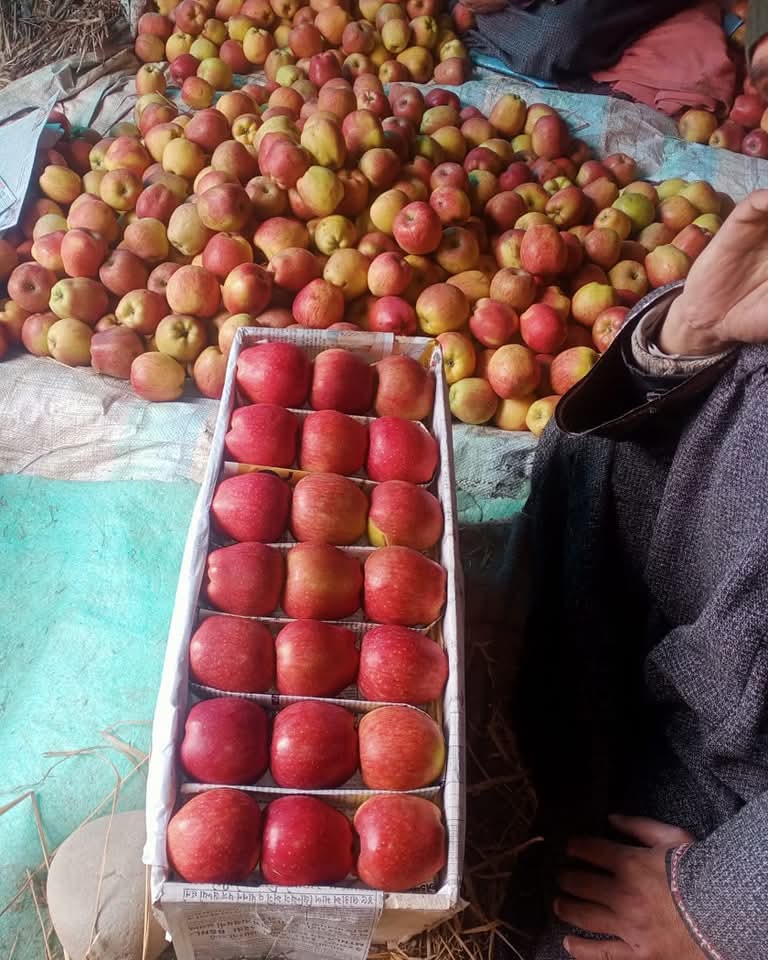
Srinagar, J & K : Apple productivity in Jammu and Kashmir has witnessed a decline, while almond cultivation has contracted significantly, even as the Union Territory’s overall fruit production has increased more than fivefold since 1980, according to a NITI Aayog roadmap for the development of the horticulture sector.
The findings are part of the “Roadmap for Horticulture Development in the UT of Jammu and Kashmir @ 2047,” which assesses the changing structure, productivity trends and key challenges confronting the region’s horticulture economy.
According to the report, the area under fruit cultivation expanded from 1.31 lakh hectares in 1980 to 3.44 lakh hectares in 2022. During the same period, fruit production increased from 5.6 lakh tonnes to 27.22 lakh tonnes.
However, productivity rose from 4.3 tonnes per hectare to 7.91 tonnes per hectare, suggesting that a considerable share of the growth in overall production has been driven by an expansion in cultivated area rather than a proportionate rise in productivity.
The report points out that opportunities for further expansion of the cultivated area are now limited, making productivity enhancement crucial for sustaining future growth in the horticulture sector.
Apple remains the dominant fruit crop in Jammu and Kashmir, accounting for nearly half of the total area under fruit cultivation and more than three-fourths of overall fruit production. However, the crop has experienced a decline in productivity in recent years.
NITI Aayog recorded a negative compound annual growth rate of 0.37 per cent in apple productivity between 2020-22 and 2022-23, highlighting concerns over the sector’s productivity performance.
The report has also drawn attention to the sharp decline in almond cultivation across Jammu and Kashmir. The area under almond orchards has fallen by approximately 10,000 hectares, with the decline becoming particularly noticeable in recent years.
The contraction in almond cultivation, coupled with declining apple productivity, raises concerns about the long-term sustainability of key components of J&K’s horticulture economy. Farmers are increasingly dealing with changing climatic conditions, shifting market demands, rising input costs and other production-related challenges.
To address these concerns, NITI Aayog has proposed several measures aimed at improving horticultural productivity. These include the adoption of high-density plantations, improved planting material, better-performing varieties, modern orchard management techniques and stronger agricultural extension services.
The roadmap also emphasises the need to strengthen post-harvest infrastructure, cold storage, processing facilities and market linkages, enabling growers to secure better returns and ensuring that increased production translates into higher farm incomes.
Given the crucial role of horticulture in supporting livelihoods across Jammu and Kashmir, the report calls for a shift in focus from merely expanding cultivated areas towards higher productivity, value addition, improved market access and greater resilience of the horticulture sector.
The recommendations assume added significance as the Union Territory seeks to modernise its horticulture economy and make it more competitive and sustainable in the years ahead.