
 newspop
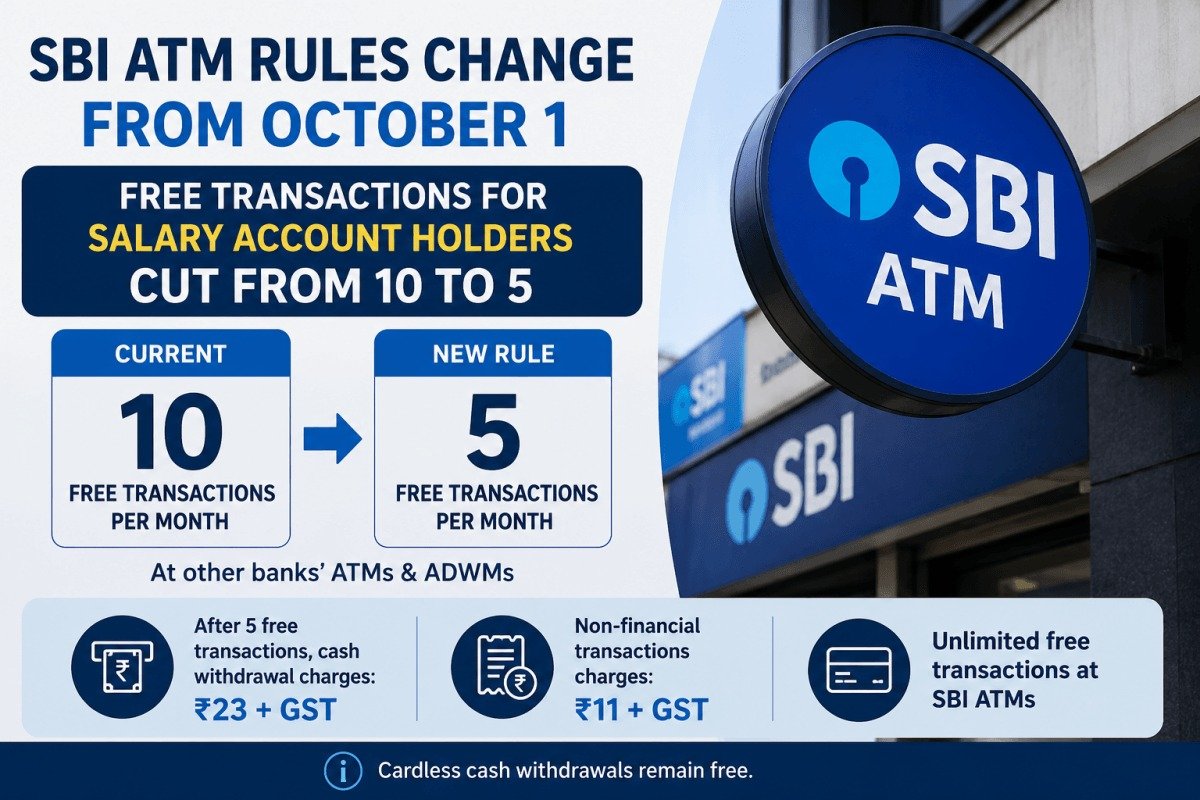
New Delhi: A new banking update is set to put the spotlight on cash withdrawals and large deposits, and some SBI customers may need to pay closer attention to the rules from October 1, 2026. The important point is that the withdrawal-related change is not applicable to every SBI savings-account holder, but specifically concerns customers maintaining a Basic Savings Bank Deposit (BSBD) account.
Under SBI’s applicable service-charge provisions, BSBD account holders are permitted four free cash withdrawals in a month, with eligible withdrawals made through both SBI branches and ATMs counted within this monthly limit. Once the four free withdrawals are exhausted, customers making additional cash withdrawals may have to pay a ₹15 charge plus applicable GST for each subsequent withdrawal.
This means customers who frequently withdraw cash from their BSBD accounts could see additional charges if they cross the monthly free-withdrawal limit. A BSBD account is a basic banking facility intended to provide essential banking services without the requirement of maintaining a minimum balance, making it particularly relevant for customers seeking a simple savings account. At the same time, another important development concerns fixed deposits and bulk deposits, with RBI regulations providing that for scheduled commercial banks, a deposit of ₹3 crore or more is treated as a bulk deposit.
Banks have greater flexibility in determining interest rates for such large deposits, subject to applicable regulatory requirements and their own policies, while customers should be able to access relevant information about the interest rates and terms offered. For ordinary customers, the key takeaway is that the four-withdrawal limit should not be mistaken for a new blanket rule covering every SBI savings account; customers should first check whether their account is actually classified as a BSBD account.
Those holding large fixed deposits or planning to place substantial amounts in a bank should also carefully check the applicable bulk-deposit classification, interest-rate terms, tenure, premature-withdrawal conditions and other charges before making a financial decision.
As October 1 approaches, customers are advised to check their account type, review the latest SBI and RBI notifications, and understand the charges applicable to their specific account rather than relying on social-media messages or incomplete information. The banking changes have therefore drawn attention not because every customer will face a new charge, but because different account categories and deposit sizes are subject to different rules, making it important for customers to know exactly which provisions apply to them.