
 newspop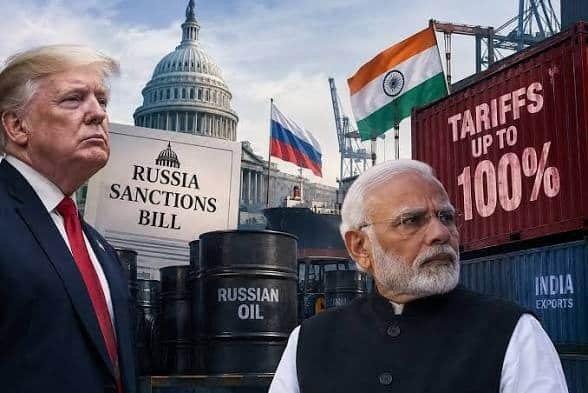
India Buys Russian Oil, Trump Gets 100% Tariff Power—What Happens Next ?
A major new development in the US-Russia economic confrontation has put India’s energy trade under renewed scrutiny. US President Donald Trump has signed the Lindsey O. Graham Sanctioning Russia and Iran Act of 2026, giving the US administration the authority to impose tariffs of up to 100% on countries buying Russian oil and gas, including major buyers such as India and China.
The measure is aimed at increasing economic pressure on Russia over the Ukraine war, but its potential impact extends to countries that continue importing Russian energy. India remains heavily dependent on imported crude, with Russia accounting for around 45% of its crude imports in August 2026.
Kpler data cited by Financial Express showed that India imported approximately 2.08 million barrels per day of Russian crude in August, down 26.3% from July, but Russia still remained India’s largest crude supplier. If Washington were to actually impose the maximum tariff on Indian goods under the new law, the consequences could extend beyond bilateral trade and put additional pressure on Indian businesses and the broader economy.
At the same time, any major disruption to Russian oil supplies could force Indian refiners to seek more crude from alternative suppliers, potentially increasing procurement, freight and insurance costs. Analysts have already noted that the price advantage of Russian crude has narrowed, while India has increased purchases from sources including Venezuela, Iraq and Angola.
The key point, however, is that a 100% tariff on India has not automatically been imposed; the new law gives the US President the authority to use such tariffs against countries covered by the legislation. India has maintained that its energy security remains a priority, with the government stressing its commitment to securing energy for its population.
Any future tariff action could therefore become a major test for India-US trade relations, while also raising questions about global oil flows, import costs and the possible knock-on effects on fuel prices. For now, the biggest question is not whether a 100% tariff has already hit India but whether Washington will actually use the newly granted power, and how New Delhi and global energy markets respond if it does.


 Mudasir Maqbool