
 newspop
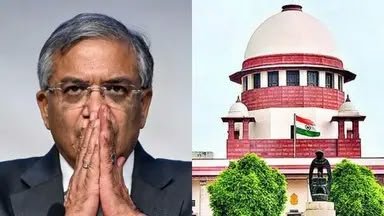
Will Quash Decisions if Taken Unilaterally : Supreme Court
New Delhi : Significant news has emerged from the Supreme Court regarding allegations that Chief Election Commissioner (CEC) Gyanesh Kumar took “unilateral decisions” within the Election Commission of India (ECI) by sidelining the other two Election Commissioners Sukhbir Singh Sandhu and Vivek Joshi.
A bench led by Chief Justice of India (CJI) Surya Kant has categorically refused to issue any interim order for the immediate suspension of Chief Election Commissioner Gyanesh Kumar from his post. However, acknowledging the gravity of the matter, the apex court has issued a notice to the Election Commission seeking its response.
While hearing the petition, the bench led by Chief Justice Surya Kant clearly indicated that if, upon reviewing the Election Commission’s response, it is proven that decisions were made in disregard of rules and consensus, the court would not hesitate to overturn those decisions.
During the hearing, the CJI’s bench stated, “Let the response to the notice come in. If it emerges from the Election Commission and the records that certain decisions were taken unilaterally without the consensus or majority support of the three-member commission we will quash all those decisions.”
Senior Advocate Vikas Singh sought the suspension of the CEC’s powers or the withdrawal of his authority pending the conclusion of the hearing. In a related petition, Senior Advocate Menaka Guruswamy raised questions regarding changes made to ‘Form 6’ and alleged major flaws in the SIR process. The court had clubbed these matters together. Senior Advocate Menaka Guruswamy states that the challenge concerns the functioning of the Election Commission as a national institution. She stands by her arguments questioning the conduct of the CEC.
She told the Court, “We grew up in an environment of fair and independent elections in this country. That is not the situation today.” To this, CJI Surya Kant remarked, “We also do our homework. We are also aware of the matter.”
The Supreme Court was hearing petitions challenging the alleged “unilateral” decisions taken by Gyanesh Kumar decisions in which he did not involve his two fellow Election Commissioners. These petitions were filed following a news investigation report claiming that Election Commissioners Sukhbir Singh Sandhu and Vivek Joshi had officially registered objections at least 14 times over the past 10 months regarding decisions and orders issued by the CEC. They contended that these decisions and orders were issued without their knowledge or recommendation.
While hearing the petitions on Monday, CJI Surya Kant observed, “They are expected to take decisions by consensus… if consensus is not reached, the decision should be taken by a majority. Today, you are speaking based merely on a news report.”
The Chief Justice added, “A news report could be entirely or partially accurate. We would like to know their response to this.” Senior Advocate Menaka Guruswamy said, “Let me give you an example, as this is a recent matter concerning Delhi. Look at how the SIR was conducted in Delhi. Two new conditions were added to Form-6. A modified Form-6 was issued. Form-6 is part of the RPA schedule; it cannot be altered in this manner.”
The Chief Justice clarified, “Please note that we have not approved any modified Form-6.”
Petitions filed in the Supreme Court have raised serious questions regarding the Election Commission’s functioning and the ‘Special Intensive Revision’ (SIR) process.
The petitioners (Rakesh Kumar Singh and others) allege that Chief Election Commissioner Gyanesh Kumar implemented several policy and software changes without the consent of the other two Election Commissioners, thereby violating the multi-member nature of the Commission.
The petition claims that appeals were filed against the reinstatement of over 16.10 lakh voters in West Bengal—ordered by judicial officers—without the knowledge of the other two Election Commissioners or the State’s Chief Electoral Officer (CEO). Meanwhile, in Goa, the facility to restore 97 eligible voters on the portal was removed entirely.
The petitions sought to have all guidelines and decisions issued by the Chief Election Commissioner without the consent of the full Commission declared unconstitutional and void.
While the Supreme Court rejected the plea to suspend the Chief Election Commissioner as an immediate measure, it has brought the ECI’s internal functioning under the scope of judicial review by seeking a response from the Election Commission.
Based on the affidavit to be filed by the Election Commission and records regarding the routing of files, the Supreme Court will determine whether the established procedures for a multi-member commission under the ECI Act, 1991, were violated.


 Mudasir Maqbool