
 newspop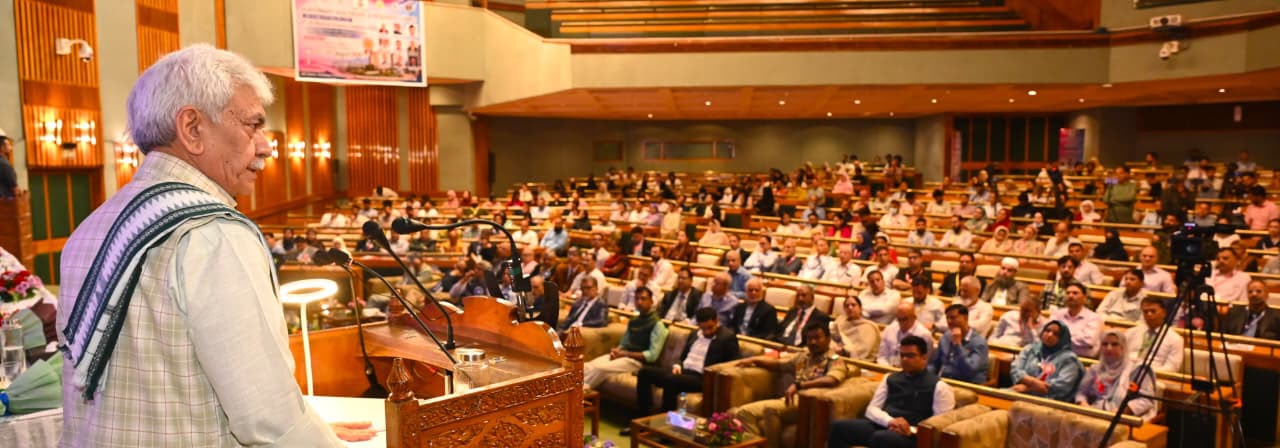
Advanced Healthcare Must Be a Right, Not a Privilege: Lieutenant Governor
Srinagar, J & K : Lieutenant Governor Manoj Sinha on Wednesday advocated for the establishment of a Quaternary Healthcare Corridor in Jammu and Kashmir, the broader implementation of AI-driven diagnostics, and a dedicated Biomedical Research Mission to ensure that advanced medical care is accessible to all residents of the Union Territory.
Speaking at the Quaternary Healthcare & Research Summit in Srinagar, the LG hailed the event as a significant step forward in the healthcare journey of Jammu and Kashmir and the nation. He underscored the need to progress beyond tertiary care by bolstering quaternary-level treatment, specialized medical services, and cutting-edge research. Sinha emphasized that high-end healthcare should not be confined to major cities or the wealthy.
“Quaternary care must not remain a privilege for the affluent. It should be a citizen’s right and a national guarantee,” he stated.
Reflecting on his 2020 visit to Akhnoor during the Back to Village program, Sinha recalled discussions with doctors about diagnosing rare diseases and the availability of modern medical equipment, which revealed a gap between the infrastructure at district hospitals and the specialized care patients often need. He called for bridging this gap as a top priority and urged stronger linkages between district hospitals, tertiary institutions, and advanced quaternary centers.
Highlighting India’s healthcare progress, the LG credited Prime Minister Narendra Modi’s leadership for expanding access and strengthening infrastructure. He noted that over 56 crore citizens have benefited from free treatment, while annual vaccination drives cover roughly 7 crore children. He also pointed to the growth of e-Sanjeevani, which delivers telemedicine services to millions each year. The expansion of institutions like AIIMS and medical colleges has further reinforced the country’s healthcare ecosystem, he added.
In Jammu and Kashmir specifically, Sinha cited the establishment of two AIIMS, 10 medical colleges, two State Cancer Institutes, a Bone and Joint Hospital, a Paediatric Hospital, 52 nursing colleges, 23 paramedical colleges, and five pharmacy colleges.
“India has successfully advanced primary, secondary, and tertiary care. Now it is time to upgrade tertiary hospitals into quaternary centers,” he said.
Calling for a deeper integration of treatment and research, the LG urged hospitals to evolve into hubs that deliver highly specialized care while pursuing pioneering medical research. He stressed the need to enhance capabilities in organ transplantation, robotic surgery, precision medicine, advanced genomics, cellular therapies, and AI-assisted diagnostics.
Sinha also advocated for dedicated annual budget allocations for advanced infrastructure and emerging technologies, including robotic surgery, gene therapy, proton-beam therapy, and AI-based diagnostic systems.
“Advanced care requires advanced specialists,” he remarked, emphasizing the expansion of fellowships and specialized training in areas like organ transplantation, oncology, genomics, and critical care.
The LG proposed developing a Quaternary Healthcare Corridor that would connect district hospitals and tertiary centers with advanced quaternary facilities. Such a network, he said, could enable faster diagnostics, advanced imaging, specialist consultations, and referrals, reducing delays in accessing top-tier treatment. He also called for integrating telemedicine and AI-enabled diagnostics into Jammu and Kashmir’s healthcare framework.
Additionally, Sinha proposed a dedicated Biomedical Research Mission involving Jammu and Kashmir, Himalayan states, universities, hospitals, private institutions, scientists, and innovators. This initiative, he said, could foster advanced biomedical research while tackling funding and infrastructure hurdles faced by medical science institutions.
“We must create our own innovations rather than importing them from abroad,” Sinha urged, calling for stronger collaboration among government bodies, private hospitals, universities, researchers, and innovators. He stressed the importance of building an ecosystem capable of producing indigenous medical technologies and solutions.
The LG also urged that hospitals be regarded as strategic national assets, akin to highways and ports, with sustained investment in their modernization, expansion, and upkeep. He asserted that Jammu and Kashmir must develop a robust quaternary healthcare system that ensures equal access to advanced treatment, irrespective of economic status.
“We need a solid quaternary-care framework that guarantees equal access—whether for a farmer’s son or a city millionaire,” he said.
Acknowledging that this goal demands persistent effort, Sinha called on all stakeholders to collaborate on a comprehensive strategy for the timely and effective rollout of quaternary healthcare and biomedical research initiatives.
During the event, the LG also released the Summit Souvenir and several publications. Attendees included Dr. M. Srinivas, Member of NITI Aayog; Chief Secretary Atal Dulloo; Dr. Digambar Behera, President of the National Academy of Medical Sciences; Dr. Kameshwar Prasad; M. Raju, Commissioner Secretary of the Health and Medical Education Department; Prof. M. Ashraf Ganie, Director of SKIMS; along with heads of various institutions, researchers, scientists, and senior officials.
Report By – Mudasir Maqbool