 newspop
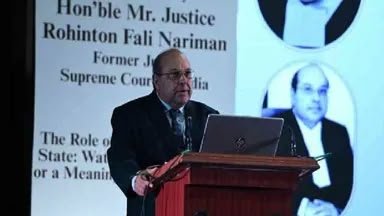
The SC also failed to take concrete steps to halt it: Retired Justice Rohinton Fali Nariman
Rajkot, Gujarat : Amid the ongoing controversy surrounding Chief Election Commissioner (CEC) Gyanesh Kumar and the Special Intensive Revision (SIR) of electoral rolls, retired Supreme Court Justice Rohinton Fali Nariman has also raised questions about the SIR process, stating that the removal of citizens in such a completely unlawful manner is downright illegal. Furthermore, he urged the apex court to expedite its verdict on the petition challenging the law governing the appointment of Election Commissioners.
He questioned the Election Commission’s functioning and its methods of deleting voters’ names through the SIR process. Justice Nariman’s remarks echo the sentiments expressed earlier by Supreme Court Justice Ujjal Bhuyan, who had stated that the process which deprived lakhs of Indian citizens of their voting rights constituted a violation of the constitutional order.
Nariman was speaking at a lecture titled ‘The Constitution and the Common Man’ at Rajkumar College in Rajkot. His criticism focused primarily on the voter SIR process and the independence of the Election Commission. According to a report by LiveLaw, Nariman stated, “You cannot have an Election Commission that functions in this manner or fails to function properly.”
He also questioned why the Supreme Court did not stay the SIR process despite the deletion of voters’ names on such a massive scale. He further stated, “In the West Bengal elections, 90 lakh voters were deprived of their right to vote; this is a staggering figure. Despite 90 lakh voters losing their rights, the Supreme Court did not take any concrete steps to halt this.”
This figure of 90 lakh includes individuals whom the Election Commission had categorized as deceased or permanently relocated. He remarked, “Of those deprived of the right to vote, approximately 22 lakh voters filed appeals. The remaining individuals likely lack the means to seek justice. And among these 22 lakh voters, 93 percent of the decisions regarding the appeals of about 1 lakh voters were in their favor.”
Nariman alleged that this process of removing names impacted both citizens’ rights and the election results. He said, “So, you can imagine that this amounted to completely sidelining the common man the ordinary citizen of India to enable the government to achieve its desired outcome. In West Bengal, we saw this lead to the ousting of the incumbent government and the ascent of the central government to power. These are deeply concerning developments taking place in our country today.”
Nariman also questioned the government’s influence over the appointment of Election Commissioners, arguing that mere protection against removal cannot guarantee their independence. He stated, “I hope the Supreme Court an institution I was once associated with will intervene immediately and rectify these matters.” It is worth noting that the Supreme Court has frequently dealt with cases concerning SIR (Systematic Deletion of Voters), a trend that began in Bihar.
In a case concerning Bihar, Justice Joymalya Bagchi told the petitioners, “Now that the ECI is issuing a revised draft, your concern is that approximately 65 lakh voters might be left out. As a judicial authority, we are monitoring this. If people are removed on a large scale, we will intervene. Just bring us 15 such living individuals whose names have been omitted.”
Since then, the SIR process has been implemented across India, and approximately 13 crore names have been removed. Despite the Supreme Court repeatedly stating that the removal of names under the SIR process would not affect citizenship, those whose names were deleted have faced numerous hardships such as being denied government benefits or the police refusing to clear passport verifications for individuals whose names do not appear in the SIR. Notably, in a separate remark made on Sunday, sitting Supreme Court Justice Ujjal Bhuyan stated that any process depriving lakhs of Indian citizens of their right to vote would violate the constitutional order.
Speaking at the valedictory ceremony of the 19th Justice Bodh Raj Sawhney Memorial Moot Court Competition at NALSAR University of Law in Hyderabad, he remarked, “No amount of ‘ifs and buts’ can justify this.”
Report : Abhijit Tushar Bhatt (Political Editor)



 Mudasir Maqbool